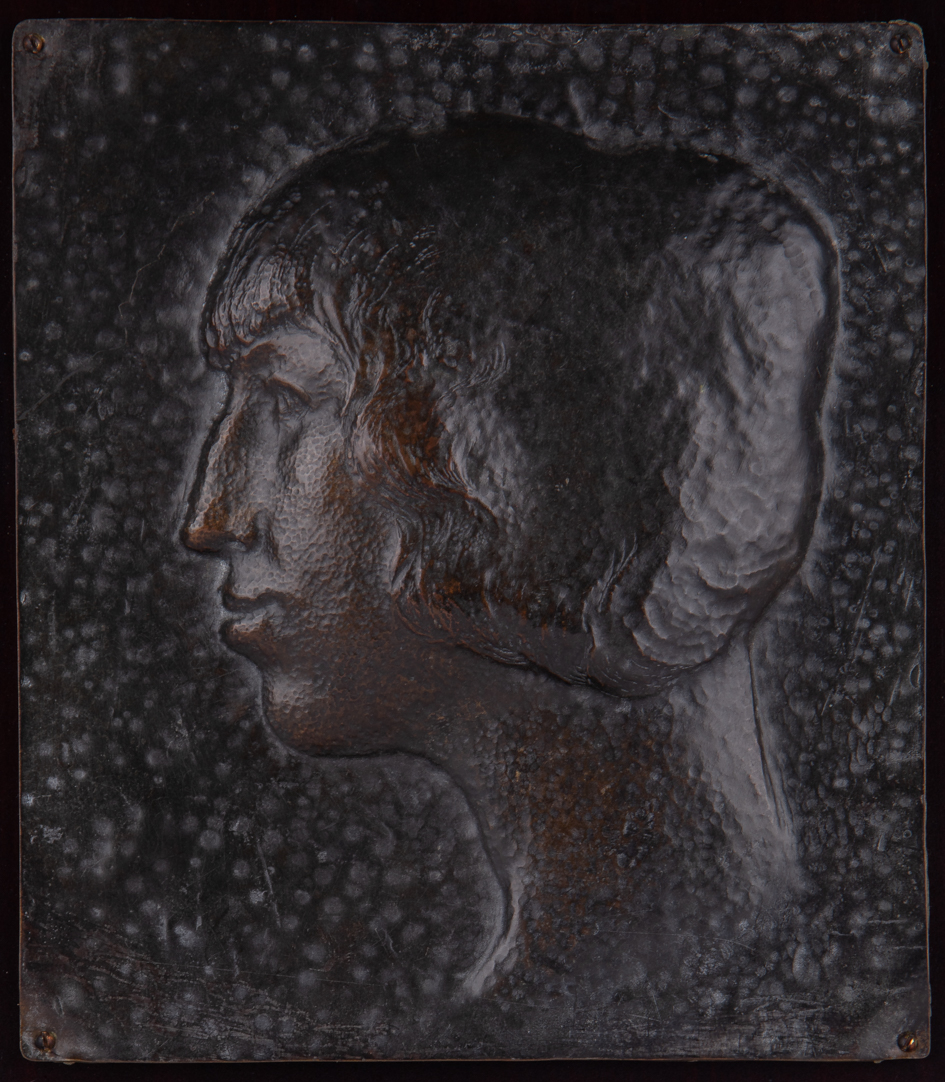
Pablo Gargallo
Magali's Profile 1913
Embossed copper relief – unique piece
16,5 x 14,7 x 1,4 cm
Provenance
- France, the artist’s studio
- France, the artist’s family
Bibliography
- 1970 EXPOSITION : Gargallo, Paris, musée Rodin, 1970, cat.21.
- 1973 COURTHION : Courthion, Pierre, Pablo Gargallo, catalogue raisonné par Pierrette Anguera-Gargallo, XXe Siècle, Paris, 1973, repr. n°42.
- 1979 ANGUERA : Anguera, Jean, Pablo Gargallo, éditions Carmen Martinez, 1979 Paris.
- 1980-1981 EXPOSITION : Pablo Gargallo, musée d’art moderne de la ville, 18 décembre-1er mars, n°23.
- 1994 MUSEO PABLO GARGALLO : Ordóñez Fernández, Rafael, Museo Pablo Gargallo, ayuntamiento de Zaragoza, Electa, 1994, repr. p.84-85 (le bronze du musée).
- 1998 CATALOGUE RAISONNÉ : Gargallo-Anguera, Pierrette, Pablo Gargallo, catalogue raisonné, préface de Philippe Dagen, l’Amateur, 1998, p.108, n°52.
- 2001 EXPOSITION : Pablo Gargallo, Monnaie de Paris, 3 avril – 10 juin 2001, repr. p.26.
- 2004 EXPOSITION : Pablo Gargallo, Institut Valencia d’Art Modern, Valencia, 29 janvier- 2 mai 2004, Centre Le Bellevue, salles Les Rhunes et les Vagues, Biarritz, 25 juin-3 octobre 2004, repr. p151.
- 2004 MUSEO PABLO GARGALLO : Ordóñez Fernández, Rafael, Museo Pablo Gargallo, ayuntamiento de Zaragoza, 2004.
- 2018 CASTRES : Gargallo, le vide est plénitude, Augé, Jean-Louis, sous la direction de, Castres, musée Goya, musée d’art hispanique, 29 juin – 28 octobre 2018, repr.p.24.
Exhibitions
- 1915-1916 BARCELONE, Gargallo, Galerías Valentí, décembre-janvier.
- 1959 PARIS, jeunesse des maîtres de la sculpture du XXe siècle, musée Rodin, 16 octobre-30 novembre.
- 1966 DUISBOURG, Gargallo, Wilhem-Lehmbruck Museum, 19 novembre-31 décembre, n°16.
- 1970 PARIS, Gargallo, musée Rodin, 23 avril-8juin, cat.21
- 1971 MADRID, Gargallo, Museo Español de Arte Contemporáneo, 23 octobre-5 décembre, n°17.
- 1980-1981 PARIS, Pablo Gargallo, musée d’art moderne de la ville, 18 décembre-1er mars, n°23.
- 1981 BARCELONE, Gargallo Exposició del Centenari, Gargallo, Palau de la Virreina, 1 avril-24 mai, n°28.
- 1981 LISBONNE, Gargallo, Fondation Calouste Gulbekian, juin-juillet, n°24.
- 1981-1982 MADRID ZARAGOZA, Gargallo Exposición del Centenario, Palacio de Cristal, 20 octobre-26 novembre, La Lonja, 7 décembre-10 janvier, n°50.
- 2001 PARIS, Pablo Gargallo, La Monnaie, 3 avril-10 juin.
- 2004 VALENCIA-BIARRITZ, Pablo Gargallo, Institut Valencia d’Art Modern, 29 janvier- 2 mai, Centre Le Bellevue, salles Les Rhunes et les Vagues, Biarritz, 25 juin-3 octobre.
- 2018 CASTRES : Gargallo, le vide est plénitude, Castres, musée Goya, musée d’art hispanique, 29 juin – 28 octobre 2018.
This embossed metal plaque is a unique work of art.
It is the original that enabled a bronze edition to be produced.
This edition includes seven numbered casts, three artist's proofs, and one bronze “museo Pablo Gargallo”.
Two bronzes are located in museums:
- Madrid, Museo nacional centro de Arte Reina Sofia, bronze E.A.1/3, AD03606, gift of Pierrette Anguera in 2004
- Zaragoza, Museo Pablo Gargallo, bronze « museo Pablo Gargallo ».
Like a line drawing, this sensitive and faithful portrait depicts Magali Tartanson, Gargallo's partner. In 1913, the young couple met in Paris through the painter Juan Gris (see photograph below). They married in 1915 and settled in Barcelona during the war years until 1924. They then returned to Paris. The couple had a strong relationship and worked as a team, supporting each other.
A drawing from the same year, also depicting Magali in profile, in ink, can be compared to this bas-relief portrait.[1] And, also in 1913, Gargallo created a Mask of Magali [2] in cut iron, in the same spirit as the first metal sheet masks, a series begun in 1907 with the Small mask with a lock of hair. This Mask of Magali is the result of assembling various shapes cut out of sheet metal and reflects the new sculptural language that Gargallo was developing at the time, exploiting the expressive possibilities of this material: the hair is treated as strips, the eyes as buttons, and the mouth and nose are skillfully stylized.
The different modes of representation used to address the same subject during the same period clearly illustrate Gargallo's quest to find the most appropriate form of expression and also demonstrates his admiration for his wife.
In Magali’s Profile, the metal sheet is kept intact, without any cutting. The profile portrait is treated like the first painted portraits of the Renaissance, which were themselves inspired by portraits on medals. One example that comes to mind is the Portrait of Sigismondo Malatesta painted by Piero Della Francesca in the 15th century, which Gargallo saw at the Louvre. The line that outlines the silhouette of the portrait is very clearly drawn; the metal is embossed and curved until it reaches a considerable thickness across the entire head. The hair is depicted as a helmet covering the ear, with fine wavy lines engraved around the face. The facial features are rendered with finesse and accuracy. A slight dimple behind the mouth is even detectable, while the eye is perfectly positioned in a rounded line extending from the bridge of the nose to the temple. The texture of the skin is rendered by precise hammering, giving it a fine grain. In contrast, the flat background around the portrait is brought to life by much coarser hammering, creating a myriad of large dots.
In the catalogue for the 1980 exhibition at the Musée d'Art Moderne de la Ville de Paris, a handwritten note from Gargallo to Magali is reproduced in the entry dedicated to the work[3]: “Words, words, as if we would say less, dear Magali, if we thought about all the damage they cause. MOST OF THE TIME, we say them as if we were scattering our hearts in the clouds. But then a mask of wind suddenly takes the place of the face. Your friend, P.”
The relief was exhibited in 1916 at the Galeries Valenti in Barcelona and was subsequently shown in all of the artist's major exhibitions (see list above).
[1] Repr. in. 1970 EXPOSITION, cat.116 : Magali, 1913, encre, 24,5 x 19,3 cm, collection Anguera-Gargallo.
[2] 1998 CATALOGUE RAISONNÉ, n°53 : Masque de Magali, fer, 14 x 11 x 3,5 cm, succession Gargallo.
[3] 1980-1981 EXPOSITION, n°23.