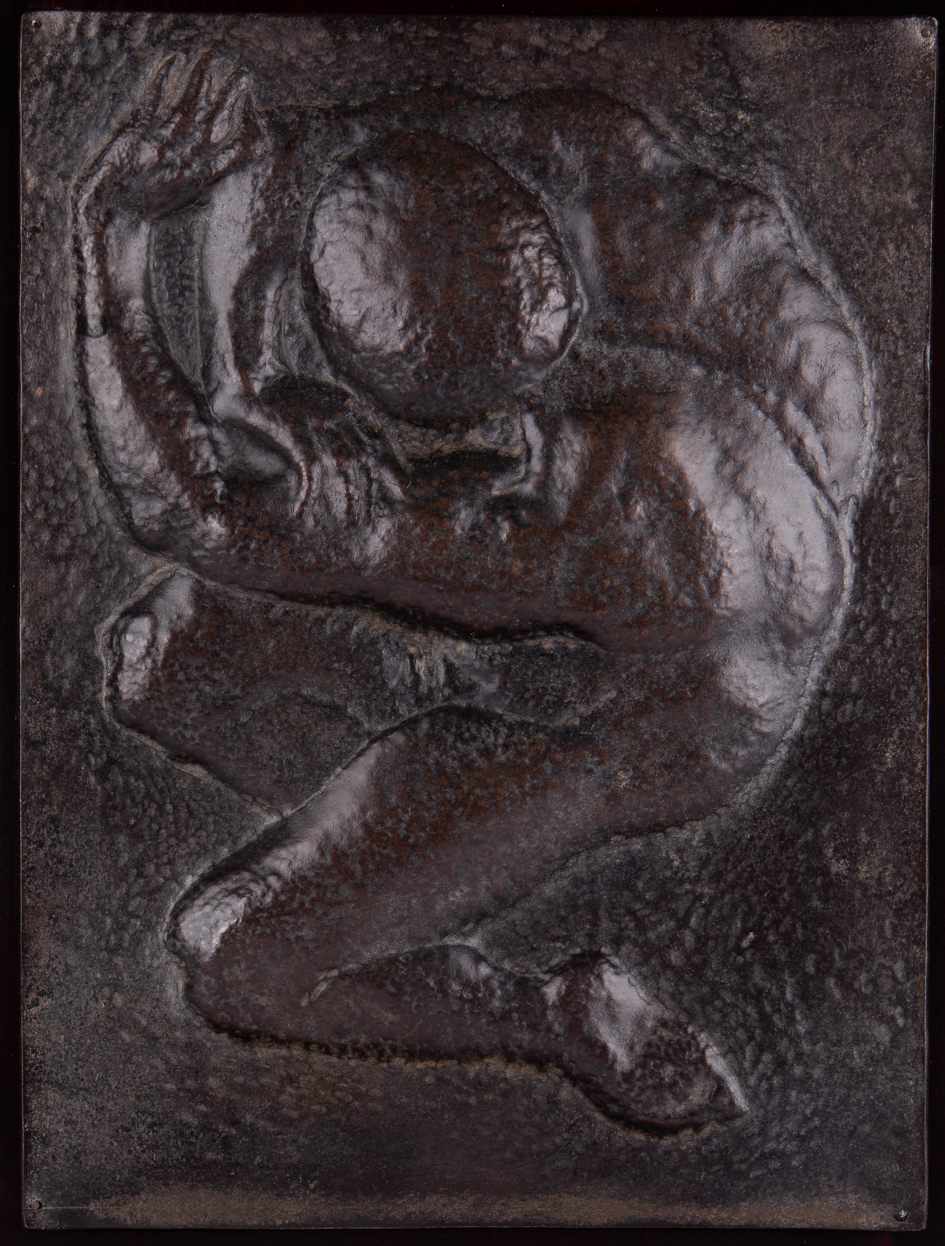
Pablo Gargallo
Cain 1916
Embossed iron relief– unique piece
24 x 18 x 1,3 cm
Provenance
- Artist’s workshop
- France, artist’s family
Bibliographie
- 1970 EXPOSITION : Gargallo, Paris, musée Rodin, 1970, cat.22 (bronze, collection Anguera Gargallo).
- 1973 COURTHION : Courthion, Pierre, Pablo Gargallo, catalogue raisonné par Pierrette Anguera-Gargallo, XXe Siècle, Paris, 1973, repr. n°51.
- 1994 MUSEO PABLO GARGALLO : Ordóñez Fernández, Rafael, Museo Pablo Gargallo, ayuntamiento de Zaragoza, Electa, 1994, repr. p.100-101 (le bronze du musée).
- 1998 CATALOGUE RAISONNÉ : Gargallo-Anguera, Pierrette, Pablo Gargallo, catalogue raisonné, préface de Philippe Dagen, l’Amateur, 1998, p.108, n°77.
- 2001 EXPOSITION : Pablo Gargallo, Monnaie de Paris, 3 avril – 10 juin 2001, repr. p.30.
- 2004 EXPOSITION : Pablo Gargallo, Institut Valencia d’Art Modern, Valencia, 29 janvier- 2 mai 2004, Centre Le Bellevue, salles Les Rhunes et les Vagues, Biarritz, 25 juin-3 octobre 2004, repr. p171.
- 2004 MUSEO PABLO GARGALLO : Ordóñez Fernández, Rafael, Museo Pablo Gargallo, ayuntamiento de Zaragoza, 2004, repr. p.129 (le bronze du musée).
- 2018 CASTRES : Gargallo, le vide est plénitude, Augé, Jean-Louis, sous la direction de, Castres, musée Goya, musée d’art hispanique, 29 juin – 28 octobre 2018, repr.p.27.
Expositions
- 1918 BARCELONE, Les Arts i els Artistes, Galeríes Laietanes, janvier.
- 1966 DUISBOURG, Gargallo, Wilhem-Lehmbruck Museum, 19 November-31 December, n°22.
- 1970 PARIS, Gargallo, musée Rodin, 23 April-8 June, cat.22.
- 1971 MADRID, Gargallo, Museo Español de Arte Contemporáneo, 23 Octobrer-5 December, n°23.
- 1975 PARIS, Sculpteurs en France de Rodin à nos jours. IVe Exposition Internationale du Petit Bronze, octobre-décembre, n°42.
- 1980-1981 PARIS, Pablo Gargallo, musée d’art moderne de la ville, 18 December-1er March, n°36.
- 1981 BARCELONE, Gargallo Exposició del Centenari, Gargallo, Palau de la Virreina, 1 avril-24 mai, n°36.
- 1981 LISBONNE, Gargallo, Fondation Calouste Gulbekian, juin-juillet, n°34.
- 1981-1982 MADRID ZARAGOZA, Gargallo Exposición del Centenario, Palacio de Cristal, 20 October-26 November, La Lonja, 7 December-10 January, n°60.
- 2001 PARIS, Pablo Gargallo, La Monnaie, 3 April-10 June.
- 2004 VALENCIA-BIARRITZ, Pablo Gargallo, Institut Valencia d’Art Modern, 29 January- 2 May 2004, Centre Le Bellevue, salles Les Rhunes et les Vagues, Biarritz, 25 juin-3 octobre 2004.
- 2018 CASTRES : Gargallo, le vide est plénitude, Castres, musée Goya, musée d’art hispanique, 29 June – 28 October 2018.
This embossed metal plaque is a unique work of art.
This work is the original that was used to create a bronze edition.
This edition comprises seven numbered works, three artist's proofs, and one “Museo Pablo Gargallo” bronze.
Only one bronze proof is located in a museum:
- Zaragoza, Museo Pablo Gargallo, “Museo Pablo Gargallo” bronze.
Religious themes interested Gargallo from the very beginning. They appear regularly in his works, notably in figures of the Prophet, David, and Pietà. Pierrette Anguera Gargallo, the artist's daughter, recounts that the sculptor always kept a Bible on his bedside table.
The character of Cain is depicted in an ink and gouache drawing from 1904[1]. The man is shown standing, fleeing and ashamed. Another even older ink and watercolor drawing, dated 1903, shows Cain curled up on himself [2], as in our relief.
In Hebrew, the name Cain means “blacksmith” or craftsman who made copper and iron instruments to turn into weapons of war. Did this etymology inspire Gargallo to take a particular interest in this character?
During the same period, Manolo, a fellow sculptor and friend of Gargallo, also excelled in bas-reliefs and crouching figures. In 1912, he created a relief of Léda et le Cygne[3] depicting Leda crouching with her back turned, with a muscular physique very similar to that of Gargallo's Cain. The two artists had similar careers, moving between noucentista Barcelona and avant-garde Paris, immersing themselves in various modern developments in art while remaining on the fringes of Cubism. As in Manolo's works, Cain features a synthetic, almost geometric vision of forms and a monolithic composition, characteristics that may also be inherited from Derain's sculpture.
[1] 2004 EXPOSITION, p.116 : Caïn, 1904, ink wash and gouache, 40 x 29 cm, artist’s family.
[2] 2004 EXPOSITION, p.170 : Caïn, 1903, ink and watercolors, 14 x 23 cm, private collection.
[3] Manolo, Léda et le Cygne, bas-relief, bronze proof, n°1, 17,3 x 17,4 cm, Galerie Malaquais.