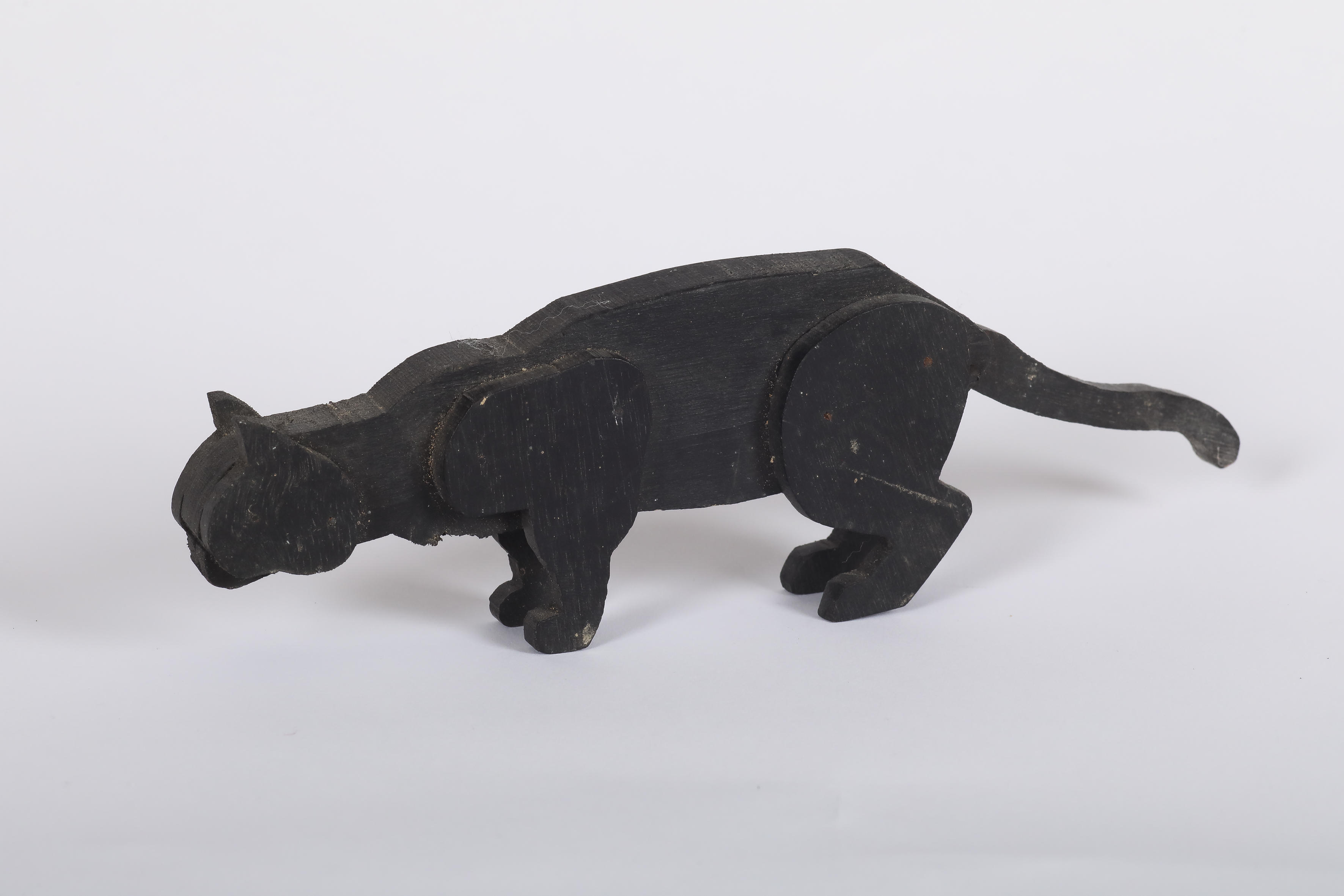
Jane Poupelet
Cat c. 1915
Articulated toy
Painted wood
6,7 x 22 x 2,8 cm
Provenance
- France, artist’s studio.
Bibliographie :
- 1930 KUNSTLER : Charles Kunstler, Jane Poupelet, Paris, Éditions G. Crès & Cie, 1930.
- 1973 WAPLER : Vincent-Fabian Wapler, Jane Poupelet sculpteur (1878-1932), mémoire de maîtrise présenté sous la direction de Monsieur Souchal, Professeur d’histoire de l’art, en mai 1973, faculté des lettres et sciences humaines de Lille III, n°54, p.198-200 (exemplaire évoqué).
- 2005 RIVIÈRE : Anne Rivière, « Jane Poupelet 1874-1932 « La beauté dans la simplicité » », in Jane Poupelet (1874-1932), catalogue d’exposition, Roubaix, La Piscine – musée d’art et industrie André Diligent (15 octobre 2005– 15 janvier 2006) ; Bordeaux, musée des Beaux-Arts (24 février – 4 juin 2006) ; Mont-de-Marsan, musée Despiau-Wlérick (24 juin – 2 octobre 2006), Paris, Éditions Gallimard, 2005, p. 110, n°151 (exemplaire reproduit).
Having studied at the Bordeaux School of Fine Arts, Jane Poupelet developed an excellent knowledge of the works of the masters of past centuries, whether European, Japanese, or Egyptian. Among her contemporaries, she frequented Lucien Schnegg, a practitioner of Rodin, and his friends. She thus became a member of the “Bande à Schnegg”[1] and, along with Charles Despiau, was one of the main ambassadors of the refined style with smooth forms inherited from the Greco-Roman tradition, breaking from Rodin's agitated art. Very early on, Jane Poupelet began to develop a bestiary consisting of domestic and farm animals. She sketched cats, chickens, roosters, cows, donkeys, and rabbits from life. She observed the animals as they moved and tracked the posture that interested her. During 1906, she moved away from naturalism and the anecdotic[2], turning animal behavior into a hieratic and timeless form. This work from nature allowed her to create sculpted figures with extremely synthetic and accurate forms.
From 1908 onwards, Jane Poupelet became part of the artistic network around her. She took part in salons and group exhibitions in France, Europe, and the United States. She was active in French and American feminist circles. The First World War interrupted her career. According to A. Salmon, she “sacrificed her future for humanity.”[3] : from 1915 onwards, she and other female artists[4] began producing toys for children[5]. A note from Poupelet lists the designs she offered, particularly animals: “rabbits, hens, roosters, chicks, cats, grasshoppers, frogs, birds, goats, and elephants.”[6]. These items are distributed by the Excelsior Gallery on the Champs-Élysées and by Janet Scudder (1869-1940) [7] in the United States. The revenues from these wooden toys were donated to charity. This production preceded the artist's work with Anna Ladd (1878-1939) at the American Red Cross office for reconstruction and rehabilitation in Paris. The two sculptors were tasked with creating masks for soldiers disfigured by war.
The motif of the cat is recurrent in her work. It was through this motif that she announced her animal-themed production, presenting five studies of cats in the form of paperweights at the 1906 Salon de la Société nationale des Beaux-Arts[8]. She depicted this animal in drawings, sketches[9], and sculptures. Several bronzes are known, such as the Crouching Cat kept at La Piscine in Roubaix, and the Lying Cat or Curled-up Cat from 1904-1905 in a private collection. Her plaster works are also noteworthy, including the Cat Licking Its Paws from 1905-1906, in a private collection, and the Cat Nursing Two Kittens from around 1906, also in a private collection, among others[10].
The toy is treated in its purest form, without detours, the lines are clean and taut, the planes architectural. It offers a universal representation of the animal, in the manner of the Egyptians. It is no longer “the portrait of a beast but rather the synthesis of a breed, generic characteristics, an attitude of absolute realism, the statuette rising to become a definitive effigy.”[11] The artist does not think in terms of subjects, let alone a “hierarchy of genres”: “To her, life is the subject”[12]. It is a game for children, and as Claude Roger Marx writes: “Under the influence of Caran d'Ache and Benjamin Rabier, the wooden toy, with its simplified joints, broke down the most comical attitudes.”[13] It would seem that the artist was influenced by a technique used by Caran d'Ache (1858-1909), which consisted of “cutting out silhouettes with a saw from plywood sheets; the limbs were attached to the body by a transverse axis that allowed them to pivot and give the animal the desired pose.”[14] t is a “fairly simple process involving thin, superimposed layers”[15] that “reduces the number of viewpoints to two, which can only be lateral.”[16] Although the limbs of our model are not movable, it does have an articulated tail that can be raised or lowered. These objects are nevertheless genuine sculptures, and were referred to as “artistic toys” at an undated exhibition[17].
This painted wooden Cat is representative of Jane Poupelet's style, but also of her character and commitments. It is characteristic of her work during the First World War, the proceeds of which were used to support those affected by the war. Ultimately, it reflects the artist's desire to transform sculpture, particularly female sculpture, into a “social activity”[18].
[1] 2005 RIVIERE, p. 33.
[2] 2005 RIVIERE, p. 39.
[3] Cité dans 1973 WAPLER, p. 202.
[4] 1973 WAPLER, p. 198: « A file kept by Jane Poupelet contains a list written by Janet Scudder of the artists whose toys she distributed in the United States, in Philadelphia. These artists are all unmarried women: Miss Pauline Adour, Miss Gaillard, Miss Johnson, Miss Lecomte, Miss de Felce, Miss Muffat, Miss Elizabeth Nourse, Miss Picard, Miss Poupelet, Miss Piramowicz, Miss Swiecka, Miss de Sakalski, and Miss Vérita ».
[5] Pour des reproductions en couleur de jouets produits par l’artiste, voir 2005 RIVIERE, p. 110-111.
[6] 1973, WAPLER, p. 199.
[7] Janet Scudder was an American medalist, sculptor, and painter. She studied at the Cincinnati Art Academy in the studio of sculptor Louis Rebisso. She moved to Chicago and completed her training at the Art Institute under the guidance of artist John Vanderpoel. She worked with sculptor Lorado Taft, who employed female practitioners. They participated in the construction of the 1893 World's Fair. On this occasion, Scudder received a personal commission for two sculptures for the Illinois and Indiana pavilions. She decided to cross the Atlantic to complete her training in Paris, where she would rub shoulders with Jane Poupelet.
[8] 2005 RIVIERE, p. 38.
[9] Jane Poupelet, Chat lapant, croquis, vers 1906, reproduit dans 2005 RIVIERE, p. 39.
[10] Voir 2005 RIVIERE, p. 102-104. Un bronze de Chat lapant est également répertorié.
[11] Maurice Guillemot, « Jane Poupelet », Art et Décoration, décembre 1913, n°12, p.56, cité dans 2005, RIVIERE, p. 38-39.
[12] 1930 KUNSTLER, p.7.
[13] Claude Roger Marx, Art vivant, n°179, 1933, cité dans 1973, WAPLER, p. 200.
[14] 1973 WAPLER, p. 200.
[15] 1973 WAPLER, p. 200.
[16] 1973 WAPLER, p. 200.
[17] 1973 WAPLER, p. 200.
[18] 2005, RIVIERE, p. 60.