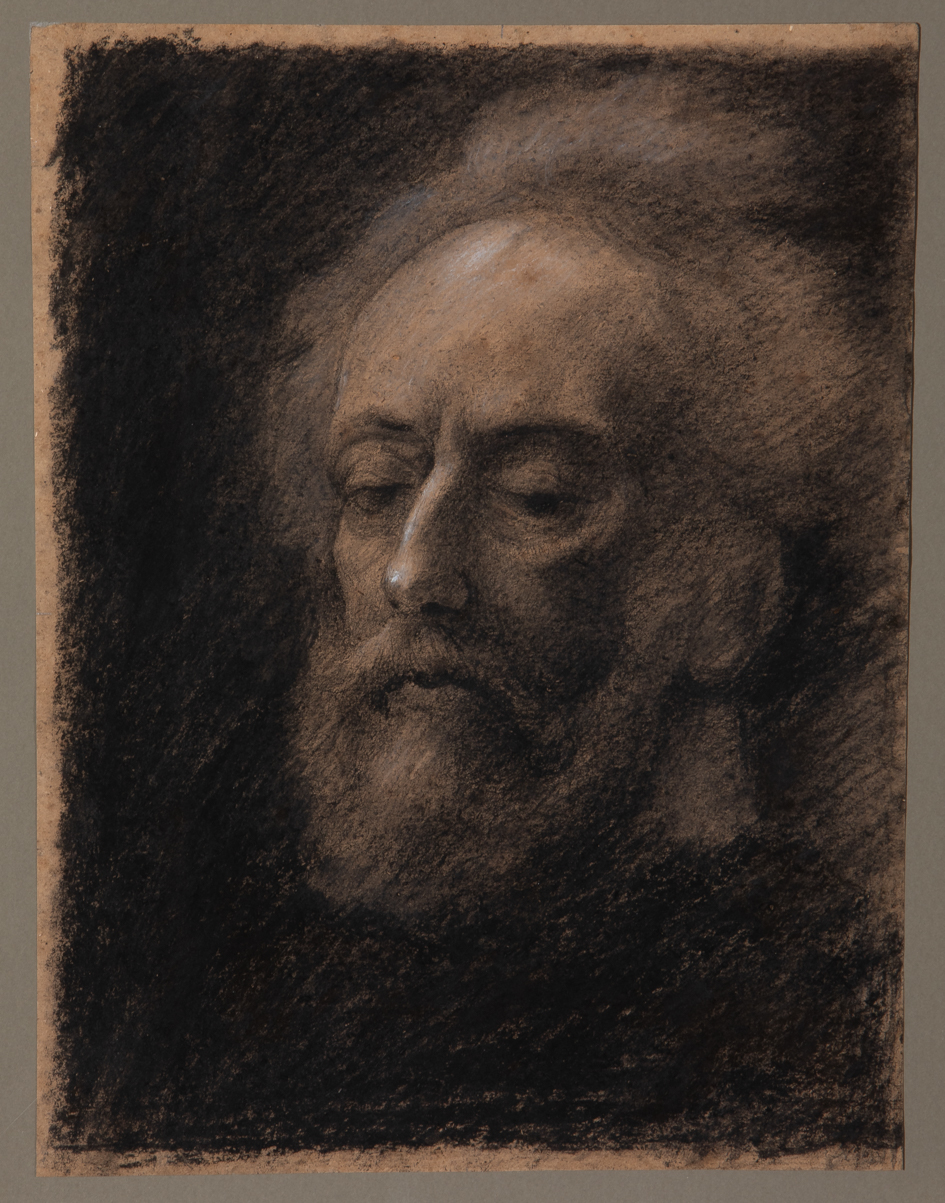
Jean-Baptiste Carpeaux
Portrait of Bruno Chérier 1874
Charcoal and white chalk highlights
38 x 29 cm
Provenance
- France, Private Collection
Bibliography
- 1880 CHESNEAU : Ernest Chesneau, Le statuaire J.-B. Carpeaux. Sa vie et son œuvre, Paris, A. Quantin, Imprimeur-éditeur, 1880.
- 1913 LARAN- LE BAS-VITRY : Jean Laran, Georges Le Bas, Paul Vitry, Carpeaux (L’Art de notre temps), Paris, Librairie centrale des Beaux-Arts, 1913, n°X, NP, repr. (Valenciennes, Musée des Beaux-Arts).
- 1913 MARGUERITTE : Victor Margueritte, « Préface », in Atelier J.-B. Carpeaux (Deuxième et dernière Vente), catalogue de vente [commissaire-priseur Henri Baudoin, experts Durand-Ruel & fils, J. & G. Bernheim-Jeune, Paris, Galerie Manzi-Joyant, 8-9 décembre 1913], Paris, Imprimerie de l’Art, 1913.
- 1934 CLÉMENT-CARPEAUX : Louise Clément-Carpeaux, La Vérité sur l’œuvre et la vie de J.-B. Carpeaux, t. I, Paris, Dousset et Bigerelle Imprimeurs, 1934.
- 1935 CLÉMENT-CARPEAUX : Louise Clément-Carpeaux, La Vérité sur l’œuvre et la vie de J.-B. Carpeaux, t. II, Nemours, Imprimerie André Lesot, 1935, NP, repr.
- 1975 CATALOGUE EXPOSITION PARIS : Sur les traces de Jean-Baptiste Carpeaux, catalogue d’exposition [Paris, Grand Palais, 11 mars – 5 mai 1975], Paris, Éditions des musées nationaux, 1975.
- 1989 DE MARGERIE : Laure de Margerie, Carpeaux, la fièvre créatrice, Paris, Gallimard-Réunion des Musées Nationaux, 1989.
- 1999 CATALOGUE EXPOSITION VALENCIENNES-PARIS-AMSTERDAM : Patrick Ramade, Laure de Margerie (commissariat de), Carpeaux peintre, catalogue d’exposition [Valenciennes, Musée des Beaux-Arts, 8 octobre 1999 – 3 janvier 2000, Paris, Musée du Luxembourg, 24 janvier – 2 avril 2000, Amsterdam, Musée Van Gogh, 21 avril – 27 août 2000], Paris, Éditions de la Réunion des musées nationaux-Musée des Beaux-Arts de Valenciennes, 1999.
- 2008 CATALOGUE EXPOSITION VALENCIENNES : Emmanuelle Delapierre (commissariat de), Carpeaux/Daumier, dessiner sur le vif, catalogue d’exposition [Valenciennes, Musée des Beaux-Arts, 18 septembre 2008 – 11 janvier 2009], Valenciennes, Musée des Beaux-Arts de Valenciennes, 2008.
- 2010 GUILLOT : Catherine Guillot, Bruno Chérier (1817-1880). Peintre du Nord, ami de Carpeaux, Villeneuve d’Ascq, Presses universitaires du Septentrion, 2010, n°16, p. 35, repr. (Valenciennes, Musée des Beaux-Arts).
- 2012 CATALOGUE EXPOSITION PARIS : Emmanuelle Brugerolles (sous la direction de), Jean-Baptiste Carpeaux Dessinateur, catalogue d’exposition [Paris, École nationale supérieure des beaux-arts, 15 novembre 2012 – 9 février 2013], Paris, Beaux-Arts de Paris les éditions-Ministère de la Culture et de la Communication, 2012.
- 2014 CATALOGUE EXPOSITION PARIS : James David Draper, Édouard Papet (sous la direction de), Carpeaux (1827-1875). Un sculpteur pour l’empire, catalogue d’exposition [New York, The Metropolitan Museum of Art, 10 mars – 26 mai 2014, Paris, Musée d’Orsay, 24 juin – 28 septembre 2014], Paris, Gallimard-Musée d’Orsay, 2014, n°93, p. 218, repr. (Valenciennes, Musée des Beaux-Arts).
“What we commonly call friendships are merely acquaintances and habitual dealings formed by some occasion or convenience […]; in the friendship of which I speak, they mingle and merge into one another, in such a universal [complete] mixture that they erase and can no longer find the seam that joined them. If I am pressed to say why I loved Étienne de la Boétie, I feel that it can only be expressed by saying: because it was him; because it was me.”[1]
The friendship between Jean-Baptiste Carpeaux (1827–1875) and Bruno Chérier (1817–1880) cannot be summed up solely by their shared interest in art and beauty. It was a friendship that lasted nearly thirty years, surviving many of life's trials and tribulations, and even more so, the passage of time, as evidenced by this majestic Portrait of Bruno Chérier by Carpeaux.
The beginning of a long friendship
Carpeaux and Chérier were both born in Valenciennes. Bruno Chérier was one of the leading figures in the revival of religious art: “Between 1850 and 1880, he received the largest number of commissions for monumental religious paintings in what is now the Lille metropolitan area.”[2] Born into a family of modest means in 1817, he first trained at academies in Valenciennes, then at the École des Beaux-Arts in Paris. His first major project was Notre-Dame de Lorette in the 9th arrondissement, where he was employed “as a decorator to apply flat colors to the ornaments framing the medallions.”[3]
Jean-Baptiste Carpeaux was born ten years later, in 1827, also into a family of modest means. He initially studied at the École des Frères de la Doctrine Chrétienne, where he met the future architect Louis Dutouquet (1821-1903) and the future lawyer and patron Jean-Baptiste Foucart (1823-1898). Carpeaux would become part of an important network of Valenciennes personalities linked to the art world, and it was through one of them that he met Chérier.
In 1838, Carpeaux's father “found a job as a foreman on the Versailles Railroad.”[4] The whole family moved to Paris. There, a cousin of Carpeaux's mother, Victor Liet (1817-1847), took the young boy under his wing and took charge of his artistic education. An intellectual deeply attached to his roots, Liet made it his mission to encourage and support his compatriots. He often welcomed distinguished guests from the North to his home in Paris, including Dutouquet, Foucart, and, most notably, Carpeaux and Chérier. It was there that the two young men met for the first time. Liet also convinced the patriarch to enroll Carpeaux in a free drawing school, known as the “Petite École,” where the teaching method followed the principles of the educator Joseph Jacotot (1770-1840): “He taught him to exercise his powers of observation and visual memory, asking him to copy several reference works chosen from Antiquity or the Classical period until he knew them by heart.”[5] Carpeaux was deeply influenced by this apprenticeship and retained its fundamentals until the end of his career.
In 1848, Carpeaux and Chérier collaborated on the same project, which sealed their friendship. Foucart called on his artist friends to decorate his salon. Carpeaux created a plaster bas-relief for the occasion, La Sainte Alliance des peuples, inspired by the song of the same title by Pierre-Jean Béranger (1780-1857), while Chérier was commissioned to produce six paintings, also based on themes from the songwriter's works.
Despite a few disagreements, notably when Carpeaux was in conflict with the director of the Villa Medici over the creation of his Ugolin[6], the painter and sculptor remained close, despite the passing years and the distance between them. Their extensive correspondence has also become a valuable tool for historians, allowing them to better understand and trace the sculptor's career, sometimes down to the day.
A powerful portrait
In the early 1870s, Jean-Baptiste Carpeaux entered the final stage of his career and the end of his life. From 1873 onwards, the sculptor's health began to decline. He was diagnosed with incurable bladder cancer, which caused him to endure excruciating pain until his death on October 12, 1875. In addition, numerous family problems further clouded what was already a painful and complex end to his life.
“On April 17, 1874, Jean-Baptiste Carpeaux left his beautiful house in Auteuil and his studios, never to return. From then on, he would wander from one temporary accommodation to another, at the mercy of the conflicts of interest surrounding his work and, above all, the rights attached to it.”[7] He was first hospitalized for several months at Maison Dubois. He then stayed for a while with Bruno Chérier, before being welcomed by Prince Stirbey (1828-1925) at his estate in Nice, then in Courbevoie, where the sculptor passed away. When he left his family home and studios in early 1874, Carpeaux was already in poor health. The artist would only sculpt very rarely, when his illness gave him a little respite, and would thus focus on drawing and painting.
That is why when the two artists met in Chérier's studio, aware that Carpeaux's end was near, they both agreed to pose for each other as models. A real artistic competition emerged from this collaboration, of which our Portrait of Bruno Chérier is a part. Carpeaux immortalizes Chérier here in a powerful portrait, created using charcoal and white chalk. From this dark background, opaque and deep black, the painter's bust emerges in an evanescent, almost ghostly manner. The play of light and shadow is very elaborate, notably thanks to the touches of white chalk applied to the top of the skull, marking the graying hair, and on the nose, along the bridge and on the tip. It is a realistic portrait, created from life, and very introspective: Chérier appears with deep circles under his eyes, his gaze turned downward, lost in thought, as if deep in reflection. More than a portrait, this work is a tribute; Carpeaux presents Chérier as he perceives him, “ennobling his friend, giving him the appearance of an ancient philosopher.”[8] The curators of the exhibition Carpeaux: A Sculptor for the Empire, held at the Musée d'Orsay in 2014, said of this portrait: “Carpeaux draws impressive psychological depth from his familiarity with the model. It is, of course, a portrait of his friend, but also, to some extent, his own, embodying a particularly vivid vision of the extraordinary destinies to which many artists aspired in the 1820s, although Chérier's career was hardly an illustration of this.”[9]
A second Portrait of Bruno Chérier, also done in charcoal and white chalk and almost identical to ours, is kept at the Musée des Beaux-Arts in Valenciennes. Executed on lighter paper, the differences with our version are barely noticeable, although the copy in the Musée des Beaux-Arts seems slightly less accomplished, with less pronounced lines, less pronounced white chalk, and the drawing as a whole appearing sketchier. Our version may have been reworked in order to create the sculpted bust of Bruno Chérier.
Chérier by Carpeaux / Carpeaux by Chérier
As we have said, once reunited, the two friends embarked on a series of mutual portraits in homage to their friendship, and perhaps even with the aim of countering death. We also know of two painted portraits: the first oil on canvas is kept at the Musée des Beaux-Arts in Valenciennes, while the second was sold at auction in 2011. Finally, Carpeaux created one last portrait of his friend, this time sculpted, one of his very last busts. The bust bears a dedication on the right side of the pedestal: “A fraternal memento offered to my friend Bruno Chérier, painter. His compatriot: J.-B. Carpeaux, 1875.” We know of three plaster casts of this same bust: a first one, kept at the Calouste Gulbenkian Foundation in Lisbon; a second one, with a terracotta patina, kept at the Musée d’Orsay in Paris; and finally a third one, kept at the Musée des Beaux-Arts in Valenciennes. The bust was also cast in bronze, with some casts kept in institutions such as the Musée des Beaux-Arts in Valenciennes, or the High Museum of Art in Atlanta.
Bruno Chérier also immortalized Jean-Baptiste Carpeaux in a monumental portrait of the sculptor at work. Carpeaux is depicted in his studio, sitting on a wooden box, dressed in simple clothes, legs crossed, mallet and chisel in hand. The sculptor looks directly at us. Behind him, in the background, Chérier depicts two sculptures by Carpeaux: on the left, the Bust of Bruno Chérier, a nod to and symbol of their friendship; on the right, a smaller version of La Danse, one of the artist's masterpieces. It was this oil on canvas, measuring over 1.6 meters in height, that Chérier submitted for presentation at the 1875 Salon. Unfortunately, the work was rejected by the jury. The announcement of the news in a letter from Chérier to Carpeaux on April 18, 1875 devastated the sculptor: “It is not your work that has been rejected, it is me, me who has been rejected out of prejudice. I am doomed to ostracism. I have disrupted the established teaching. They do not want to see this revolutionary.”[10] However, Carpeaux's bronze bust of Bruno Chérier was accepted at the Salon, exhibited alongside that of Madame Alexandre Dumas fils, and “unanimously praised [...], as Castagnary sums up: “Here we see the face in action: the eyes are looking, the lips are parted, the forehead is thinking: it looks like animated bronze.” ”[11]
When Jean-Baptiste Carpeaux died, several funeral ceremonies were held. Bruno Chérier attended each one. Following the death of his friend, Chérier bequeathed several works to the Musée des Beaux-Arts in Valenciennes, including two portraits of himself by the sculptor. In a letter to Louis Dutouquet dated October 17, 1875, Bruno Chérier mentions one of his last wishes to his compatriot, that of being buried alongside Carpeaux: “Chérier also expressed the wish that Carpeaux and he be “united after death as we were during life”, resting side by side. Unfortunately, at a time when there was less concern for preserving the heritage tombs of the Saint-Roch cemetery in Valenciennes, Chérier's plot, who died without children, was taken over by the city in 1964. Thus, his grave no longer exists.”[12]. However, the unwavering friendship that bound the two artists together, and the numerous portraits they painted of each other, saved them both from oblivion and ensured their place in History.
[1] Michel de Montaigne, « De l’amitié », Essais, quoted in Émile Faguet, En lisant les beaux vieux livres, Paris, Hachette, 1912, p. 53.
[2] François Robichon, « Préface », in 2010 GUILLOT, p. 9.
[3] 2010 GUILLOT, p. 47.
[4] Nadège Horner, « Chronologie de Jean-Baptiste Carpeaux », in 2014 CATALOGUE EXPOSITION PARIS, p. 284.
[5] 1989 DE MARGERIE, p. 14.
[6] On January 4, 1859, “Chérier advised him to abandon his Ugolin, as it did not have the director’s approval, and to become a ‘religious sculptor’.” (Nadège Horner, « Chronologie de Jean-Baptiste Carpeaux », in op. cit., p. 289). « Louise Clément-Carpeaux criticized Chérier for his lukewarm response and his respect for authority in this matter. » (2010 GUILLOT, p. 29).
[7] Michel Poletti, Jean-Baptiste Carpeaux. L’homme qui faisait danser les pierres, Montreuil, Gourcuff Gradenigo, 2012, p. 169.
[8] 2010 GUILLOT, p. 37.
[9] 2014 CATALOGUE EXPOSITION PARIS, p. 218.
[10] 2010 GUILLOT, p. 32.
[11] Castagnary, « Année 1875 », Salons 1857-1878, vol. 2, 1892, p. 197, quoted in 2014 CATALOGUE EXPOSITION PARIS, p. 218.
[12] 2010 GUILLOT, p. 44.