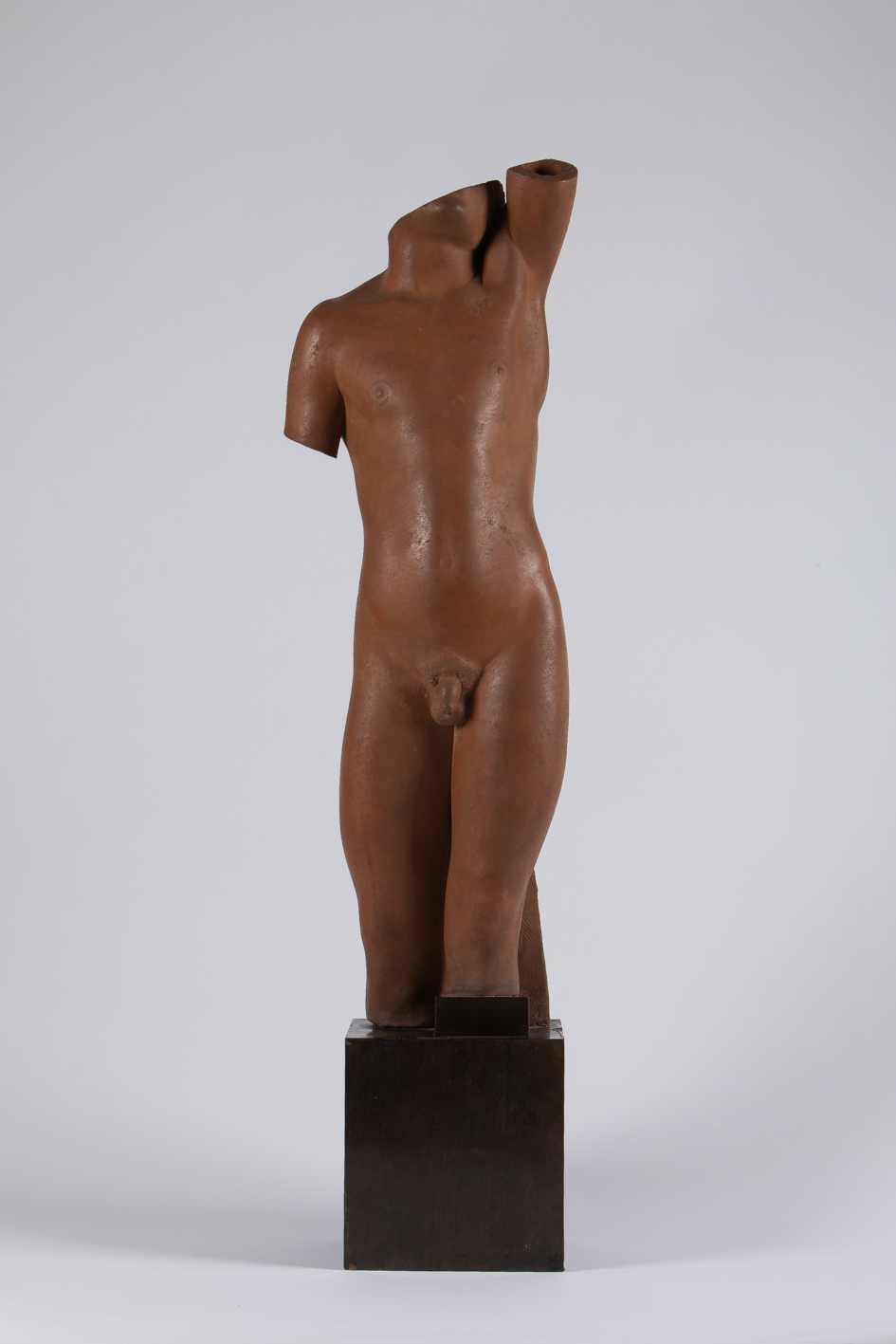
Pablo Gargallo
Gypsy Torso 1923
Terracotta
Signed (on the base, right-hand side): P. Gargallo
Numbered (on the base, right-hand side): 1/4
68 x 23 x 18,5 cm
Provenance
- France, the artist’s studio;
- France, the artist’s family.
Bibliography
- 1970 EXPOSITION : Gargallo, Paris, musée Rodin, 1970, cat.41.
- 1973 COURTHION : Courthion, Pierre, Pablo Gargallo, catalogue raisonné par Pierrette Anguera-Gargallo, XXe Siècle, Paris, 1973, repr. n°89.
- 1979 ANGUERA : Anguera, Jean, Pablo Gargallo, éditions Carmen Martinez, 1979 Paris, repr. p.100-101.
- 1994 MUSEO PABLO GARGALLO : Ordóñez Fernández, Rafael, Museo Pablo Gargallo, ayuntamiento de Zaragoza, Electa, 1994, p.120-121 (pierre).
- 1998 CATALOGUE RAISONNÉ : Gargallo-Anguera, Pierrette, Pablo Gargallo, catalogue raisonné, préface de Philippe Dagen, l’Amateur, 1998, p.129, n°105.
- 2001 EXPOSITION : Pablo Gargallo, Monnaie de Paris, 3 avril – 10 juin 2001.
- 2004 EXPOSITION : Pablo Gargallo, Institut Valencia d’Art Modern, Valencia, 29 janvier- 2 mai 2004, Centre Le Bellevue, salles Les Rhunes et les Vagues, Biarritz, 25 juin-3 octobre 2004, repr. p.204.
- 2004 MUSEO PABLO GARGALLO : Ordóñez Fernández, Rafael, Museo Pablo Gargallo, ayuntamiento de Zaragoza, 2004, repr. p.161 (la pierre du musée).
- 2018 CASTRES : Gargallo, le vide est plénitude, Augé, Jean-Louis, sous la direction de, Castres, musée Goya, musée d’art hispanique, 29 juin – 28 octobre 2018, repr.p.73.
Exhibitions
- 1970 PARIS, Musée Rodin, cat.41.
- 1980-1981 PARIS, Pablo Gargallo, musée d’art moderne de la ville, 18 décembre-1er mars, n°61.
- 1981 BARCELONE, Gargallo Exposició del Centenari, Gargallo, Palau de la Virreina, 1 avril-24 mai, n°
- 1981 LISBONNE, Gargallo, Fondation Calouste Gulbekian, juin-juillet, n°
- 1981-1982 MADRID ZARAGOZA, Gargallo Exposición del Centenario, Palacio de Cristal, 20 octobre-26 novembre, La Lonja, 7 décembre-10 janvier, n°
- 2004 VALENCIA-BIARRITZ, Pablo Gargallo, Institut Valencia d’Art Modern, 29 janvier- 2 mai 2004, Centre Le Bellevue, salles Les Rhunes et les Vagues, Biarritz, 25 juin-3 octobre 2004.
- 2018 CASTRES : Gargallo, le vide est plénitude, Castres, musée Goya, musée d’art hispanique, 29 juin – 28 octobre 2018.
“Invention, the discovery of a rhythm, is the greatest event” Gargallo[1]
“Gargallo shows us two faces, that of iron and that of earth. The cutting of metal into “intellectual” spaces and the full “sensual” form of earth are as paradoxical as they are necessary to each other, enriching each other.”[2]
Throughout his career, Gargallo oscillated between two styles, two worlds, two modes of expression. On the one hand, there are his metal works, with which he explored new modes of representation, placing him firmly within the avant-garde art movement; on the other hand, there are his sculptures modeled in clay or carved in stone, which follow the classical tradition. Gypsy Torso is, of course, a work that perfectly represents this research, heir to the vision of classical Greece. In 1923, Gargallo had just completed a series of metal and clay sculptures in which he treated solid volume through hollow form. After this experimental work, he returned to the sculpture in the round that was fundamental to him. More broadly, this interwar period corresponded to a “return to order” for many artists, led by Pablo Picasso, who sought to reinterpret the classical ideal in reaction to the deconstructions of the avant-garde.
The Gypsy Torso is based on a complete stone model carved in 1923[3], from which Gargallo removed the arms, part of the head, and the legs. He then made a plaster mold of the resulting torso, reworked it to create a bronze edition and several terracotta versions. A bronze version was exhibited at the 1950 Venice Biennale.
Gargallo is fond of depicting female nudity, but he also tried to convey a very sensitive vision of the male body on several occasions. Through this representation of the naked body, the sculptor seeks absolute beauty. The torso gives the work a certain universality; no individuality appears. However, the title tells us that it is a gypsy. The gypsy refers to a Spanish gypsy, and Gargallo had already depicted this theme in 1920-1921, with a cut-out copper Gypsy Mask[4] whose eye and mouth cavities are left empty. But here, universality dominates; it is the torso of a young man, and only the title refers to this theme. The search for expression is exclusively through the body, its treatment, its material. Gargallo began by creating a copper Torse de Femme in 1915. But the torso is a classic solution, and the sculptor would subsequently stick to matching style and subject: in 1925 and then 1934, he created the beautiful Woman’s Torso[5] and Young girl’s Torso[6] in the same spirit as the one we are studying here.
In Gypsy Torso, the pelvis shows a slight sway caused by the left leg being slightly brought forward. This dynamic element in the pose is a legacy of developments in classical Greek sculpture following the immobility of the Kourosstatues of the archaic period. But the contrapposto is more discreet here than in the figure of the Young Shepherd[7] in stone, kept at the National Museum of Catalan Art in Barcelona. The curves are soft, the details barely sketched, the forms pure. The whole is harmonious and timeless. Gargallo's terracotta has a smooth texture, a fine grain, a warm hue, and a lively, sensual “skin”. “He finds in the precise rendering of flesh, in the pulsating surface of the skin, a vital source, a knowledge, a recognition of forms that he can then more easily reconcile with the imagination of emptiness.”[8]
Our sculpture is one of four terracotta cast and retouched by Gargallo from the original plaster mold. It is signed and numbered 1/4 and comes directly from the artist's estate. The other three terracotta are held in private collections.
As for the bronze edition, it comes in two versions:
- One, with a high base, comprises five catalogued bronzes, numbered in Roman numerals. The I is kept at the Museu Nacional d'Art de Catalunya in Barcelona (inv. 004672-00).
- The other, with a low base, comprises seven bronzes numbered 1/7 to 7/7 and three artist's proofs numbered 1/3 to 3/3. The 1/7 is kept at the Museo Nacional Centro de Arte Reina Sofia in Madrid (inv. AS00684) and the 5/7 is kept in the musée Tavet in Pontoise (France).
[1] 1979 ANGUERA, p.153.
[2] Jean Anguera in. 1979 ANGUERA, p.99.
[3] 1998 CATALOGUE RAISONNÉ, n°104 : Young Gypsy (état I), 1923, stone, 71 x 24,5 x 20 cm, Museo Pablo Gargallo, inv. 046.
[4] 1998 CATALOGUE RAISONNÉ, n°88.
[5] 1998 CATALOGUE RAISONNÉ, n°120 et 121.
[6] 1998 CATALOGUE RAISONNÉ, n°204 et 205.
[7] Young Shepherd, 1918, stone, 58,7 x 27 x 15,5 cm, gift of the family in 1972, Museu nacional d’art de Catalunya, inv. 108415-000.
[8] Jean Anguera in. 2001 EXPOSITION, p.39.