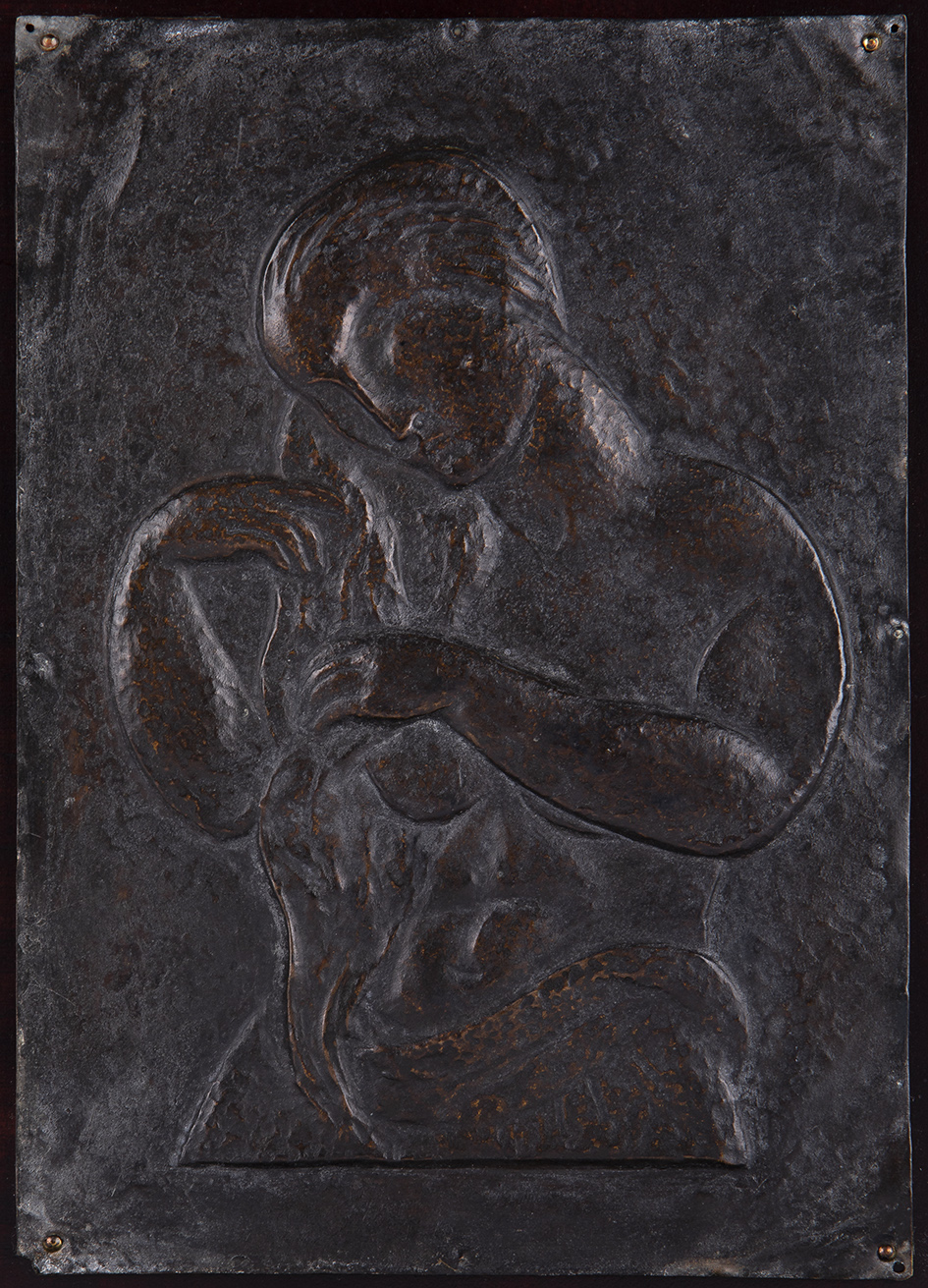
Pablo Gargallo
Woman Combing Her Hair vers 1916
Embossed copper relief – unique piece
19 x 13,5 x 0,5 cm
Provenance
- Artist’s studio
- France, artist’s family
Bibliographie
- 1970 EXPOSITION : Gargallo, Paris, musée Rodin, 1970, cat.27.
- 1973 COURTHION : Courthion, Pierre, Pablo Gargallo, catalogue raisonné par Pierrette Anguera-Gargallo, XXe Siècle, Paris, 1973, repr. n°47.
- 1998 CATALOGUE RAISONNÉ : Gargallo-Anguera, Pierrette, Pablo Gargallo, catalogue raisonné, préface de Philippe Dagen, l’Amateur, 1998, p.108, n°72.
- 1980-1981 EXPOSITION : Pablo Gargallo, musée d’art moderne de la ville, 18 décembre-1er mars, n°32.
- 2004 EXPOSITION : Pablo Gargallo, Institut Valencia d’Art Modern, Valencia, 29 janvier- 2 mai 2004, Centre Le Bellevue, salles Les Rhunes et les Vagues, Biarritz, 25 juin-3 octobre 2004, repr.p.166
- 2004 MUSEO PABLO GARGALLO : Ordóñez Fernández, Rafael, Museo Pablo Gargallo, ayuntamiento de Zaragoza, 2004, repr. p. 122 (bronze du musée).
- 2018 CASTRES : Gargallo, le vide est plénitude, Augé, Jean-Louis, sous la direction de, Castres, musée Goya, musée d’art hispanique, 29 juin – 28 octobre 2018, repr.p.28.
Expositions
- 1916 BARCELONE, Gargallo, Galeríes Laietanes, octobre.
- 1966 DUISBOURG, Gargallo, Wilhem-Lehmbruck Museum, 19 November-31 December, n°16.
- 1970 PARIS, Musée Rodin, cat.27
- 1971 MADRID, Gargallo, Museo Español de Arte Contemporáneo, 23 October-5 December, n°20.
- 1980-1981 PARIS, Pablo Gargallo, musée d’art moderne de la ville, 18 December-1st March, n°32.
- 1981 BARCELONE, Gargallo Exposició del Centenari, Gargallo, Palau de la Virreina, 1 April-24 May, n°55.
- 1981 LISBONNE, Gargallo, Fondation Calouste Gulbekian, juin-juillet, n°
- 1981-1982 MADRID ZARAGOZA, Gargallo Exposición del Centenario, Palacio de Cristal, 20 October-26 November, La Lonja, 7 December-10 January, n°55.
- 2004 VALENCIA-BIARRITZ, Pablo Gargallo, Institut Valencia d’Art Modern, 29 January- 2 May 2004, Centre Le Bellevue, salles Les Rhunes et les Vagues, Biarritz, 25 June-3 October 2004.
- 2018 CASTRES : Gargallo, le vide est plénitude, Castres, musée Goya, musée d’art hispanique, 29 June – 28 Octobrer 2018.
This embossed metal plaque is a unique work of art.
This work is the original that was used to create a bronze edition.
This edition comprises seven numbered copies, three artist's proofs, and one “Museo Pablo Gargallo” bronze.
Only one bronze proof is located in a museum:
- Zaragoza, Museo Pablo Gargallo, “Museo Pablo Gargallo” bronze.
In addition to this relief, Gargallo devoted three drawings and a sculpture made of cut copper sheets to the theme of women combing their hair.
Two drawings date from 1903. One is the Femme agenouillée se peignant, depicting a kneeling woman combing her hairin Indian ink, is kept at the Calouste Gulbenkian Foundation[1]. The other, entitled Toilette[2] shows a young woman combing her long hair, her head tilted forward. In another drawing from 1909, the Jeune femme se peignant[3], the head is again tilted forward, but with the bust slightly raised. These drawings offer glimpses of the composition of a 1931 sculpture made of cut and assembled copper plaques, entitled Femme peignant ses cheveux[4]. This sculpture is the result of developments in Gargallo's work with copper plaques. Our Femme se coiffant from 1916 is the result of the artist's first experiments with copper. Here he uses a very thin sheet of metal and the pattern is the result of the repoussé technique. “The suppleness of the modeling and the tactile richness of this small copper piece form a mannerist counterpoint to the expressionism of the cut, welded, and perforated metal plaques of the 1931 Femme se coiffant.”[5]
In Femme se coiffant, the model faces us, her head tilted to the right as she combs her long hair, which is pulled back in front of her chest. The young woman has an opulent figure with curves that are both round and taut.
During the same period, Manolo, a fellow sculptor and friend of Gargallo, also excelled in bas-reliefs and curvaceous female figures, images of voluptuous Mediterranean women. In 1912, he created a Femme assise[6] whose body has a similar morphology to Woman Combing Her Hair. The two artists had similar careers, moving between Noucentista Barcelona and avant-garde Paris, immersing themselves in various modern developments in art while remaining on the fringes of Cubism. As in Manolo's works, Femme se coiffant features a synthetic, almost geometric vision of forms and a monolithic composition, characteristics that may also be inherited from Derain's sculpture.
[1] Gargallo, Femme agenouillée se peignant, 1903, Indian ink, 33,8 x 29,5 cm, Fondation Calouste Gulbenkian, inv. DE91.
[2] 2004 EXPOSITION, p.109 : Toilette, 1903, ink and gouache, 33 x 40 cm, collection Artur Ramon.
[3] 2004 EXPOSITION, p.136 : Jeune femme se peignant, 1909, ink and watercolors, 35,7 x 25,5 cm, private collection.
[4] 2004 EXPOSITION, p.296-297 : Femme se peignant les cheveux, 1931, copper, 31 x 24,5 x 19 cm, private collection.
[5] 1980-1981 EXPOSITION, n°32.
[6] Blanch, Montserrat, Manolo, sculptures, peintures, dessins, Cercle d’art, 1974, n°35, p.36 repr. : Femme assise, 1912, bronze bas-relief, 34 x 34 cm, Munson-Williams Proctor Institute, Utica (New York).