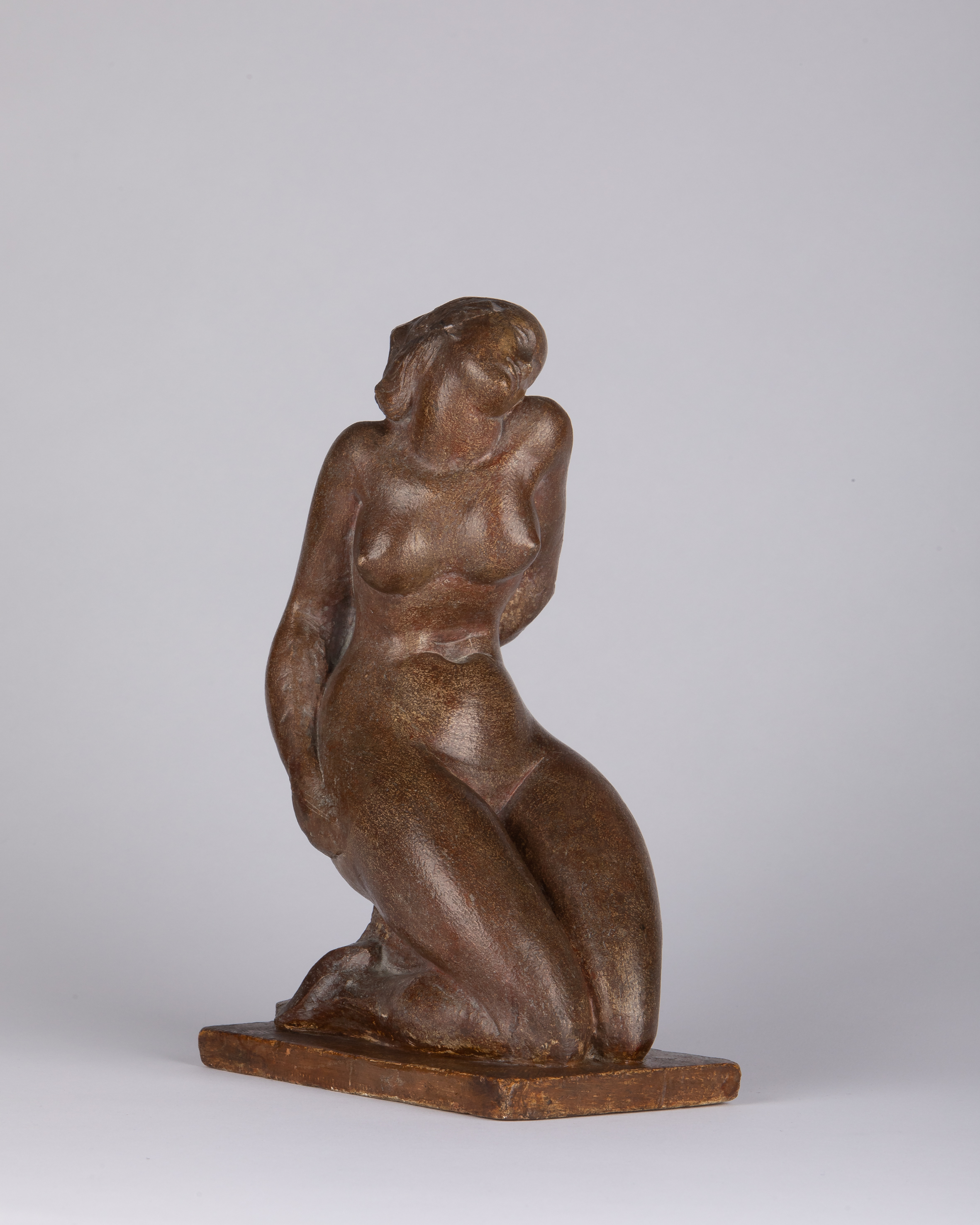
Pablo Gargallo
Small Voluptuousness Kneeling 1907
Original terracotta
Monogrammed (on the base, at the back, to the right) : PG
23 x 8,8 x 15 cm
Provenance
- The artist’s studio;
- France, the artist’s family.
Bibliography
- 1970 EXPOSITION : Gargallo, Paris, musée Rodin, 1970, cat.9 (bronze, collection Anguera-Gargallo).
- 1973 COURTHION : Courthion, Pierre, Pablo Gargallo, catalogue raisonné par Pierrette Anguera-Gargallo, XXe Siècle, Paris, 1973, repr. n°18.
- 1979 ANGUERA : Anguera, Jean, Pablo Gargallo, éditions Carmen Martinez, 1979 Paris.
- 1998 CATALOGUE RAISONNÉ : Gargallo-Anguera, Pierrette, Pablo Gargallo, catalogue raisonné, préface de Philippe Dagen, l’Amateur, 1998, p.75, n°30.
- 2001 EXPOSITION : Pablo Gargallo, Monnaie de Paris, 3 avril – 10 juin 2001, repr. p.21.
- 2004 EXPOSITION : Pablo Gargallo, Institut Valencia d’Art Modern, Valencia, 29 janvier- 2 mai 2004, Centre Le Bellevue, salles Les Rhunes et les Vagues, Biarritz, 25 juin-3 octobre 2004, repr. p.126-127.
- 2004 MUSEO PABLO GARGALLO : Ordóñez Fernández, Rafael, Museo Pablo Gargallo, ayuntamiento de Zaragoza, 2004.
- 2018 CASTRES : Gargallo, le vide est plénitude, Augé, Jean-Louis, sous la direction de, Castres, musée Goya, musée d’art hispanique, 29 juin – 28 octobre 2018, repr.p.67.
Exhibitions of the terracotta
- 1916 BARCELONE, Gargallo, Galeríes Laietanes, octobre.
- 1980-1981 PARIS, Pablo Gargallo, musée d’art moderne de la ville, 18 décembre-1er mars, n°12.
- 1981-1982 MADRID ZARAGOZA, Gargallo Exposición del Centenario, Palacio de Cristal, 20 octobre-26 novembre, La Lonja, 7 décembre-10 janvier, n°26.
- 2001 PARIS, Pablo Gargallo, La Monnaie, 3 avril-10 juin.
- 2004 VALENCIA-BIARRITZ, Pablo Gargallo, Institut Valencia d’Art Modern, 29 janvier- 2 mai 2004, Centre Le Bellevue, salles Les Rhunes et les Vagues, Biarritz, 25 juin-3 octobre 2004.
Selective exhibitions of a bronze
- 1934 BARCELONE, Gargallo, Sala Parés, 7-21 décembre.
- 1934, REUS, Gargallo, Centro de lectura, 25 décembre.
- 1937 PARIS, Maîtres de l’art indépendant, Petit Palais, juin-octobre, n°25
- 1935, BARCELONE, Exposició à l’escultor Pau Gargallo, Sala Parés, 26 janvier-8 février.
- 1947 PARIS, Rétrospective Gargallo, Arcades des jardins du Petit Palais, 9-24 mai.
- 1970 PARIS, Gargallo, musée Rodin, 23 avril-8juin, cat.9
- 2018 CASTRES, Gargallo, le vide est plénitude, Castres, musée Goya, musée d’art hispanique, 29 juin – 28 octobre 2018.
“In all compositions, there are both instinctive or intuitive proportions and scientific or empirical ones. With balance, by employing both, distortion will never occur; on the contrary, the result will be a harmonious composition.” Gargallo[1]
Small Voluptuousness Kneeling is one of the earliest examples of Gargallo’s distinctive style. As a young artist at the time, he was sculpting decorative elements for monuments in Barcelona: the Bosc Theater and the Palau de la Música Catalana. During his regular stays in Paris, he soaked up the fresh atmosphere of the avant-garde. He spent time with Picasso and saw Les Demoiselles d’Avignon. In 1907, he sparked his own revolution by creating The Little Mask with a Strand from a thin sheet of copper: “One day I started making a mask out of a sheet of metal in my studio, and when I saw the finished piece, I assure you, I leapt for joy. My heart told me I had just made a discovery! Something, my friend, that held unlimited, extremely vast possibilities.”[2]. Around the same time, he began creating several small terracotta figurines in which he gave free rein to his desires and visions: Reclining Female Faun (1906), our Small Voluptuousness Kneeling(1907) and Small Standing Female Faun all bear witness to this spirit of freedom. “It was through his series of small sculptures from 1906 to 1908 that Gargallo sought not to copy nature; but to reinvent it.”[3]
Small Voluptuousness Kneeling embodies the distinctive characteristics of Gargallo’s creative vision; a vision composed of arabesques, sensual curves, and voluptuousness. A term he uses to describe this sculpture and then another, a marble piece from 1908[4] in which he partially replicates the pose of the terracotta work. Il also took the tilted head from Small Kneeling Voluptuousness and enlarged it to create a standalone work: Tilted Head of a Woman in terracotta (1908)[5], later cast in bronze.
In Small Voluptuousness Kneeling, the waist is very narrow, while the hips and bust are wide and full. The feminine forms are accentuated. The long, rounded thighs, the arms positioned behind her to highlight her bust, and the head resting on her shoulder “convey a sensual pleasure and elegantly express a sense of delight”. The pose is characterized by exaggerated movements: the head tilted to one side, the torso bent forward and twisted, and the legs bent. This stylized posture evokes that of Hindu goddesses, in whom we find a similar combination of lines broken by complex poses and the soft curves of the flesh or the sinuous lines of Michelangelo’s sculptures.
Small Voluptuousness Kneeling presents a warm brown patina and smooth modeling, except on the back. On the back of the sculpture, the modeling is unfinished on the upper back, the hair, and the soles of the feet; the model’s left forearm and hand are missing. It appears that the figure was intended to be placed against a wall and was later detached from it.
Our Small Voluptuousness Kneeling is the original terracotta sculpture, coming directly from the artist’s studio and later from his estate. It bears the artist’s monogram, “PG.” There are two other terracotta works by Gargallo, one of which is housed at the Museum of the Abbey of Montserrat, near Barcelona.
The bronze edition of the model comprises 7 numbered examples, as well as 3 artist’s proofs, 1 non-commercial bronze (no. 1/1), and 1 “Museo Pablo Gargallo” bronze, held at the Pablo Gargallo Museum in Zaragoza, Spain. In addition, there are unnumbered casts that Gargallo gave to friends, some of which were later cataloged and numbered in the catalogue raisonné. This captivating model was undoubtedly a success.
[1] 1979 ANGUERA, p.60.
[2] Quoted in. Ordóñez Fernández, Rafael, Museo Pablo Gargallo, ayuntamiento de Zaragoza, 2004, p.58.
[3] 1979 ANGUERA, p.59.
[4] 1998 CATALOGUE RAISONNÉ, n°35.
[5] 1998 CATALOGUE RAISONNÉ, n°33.