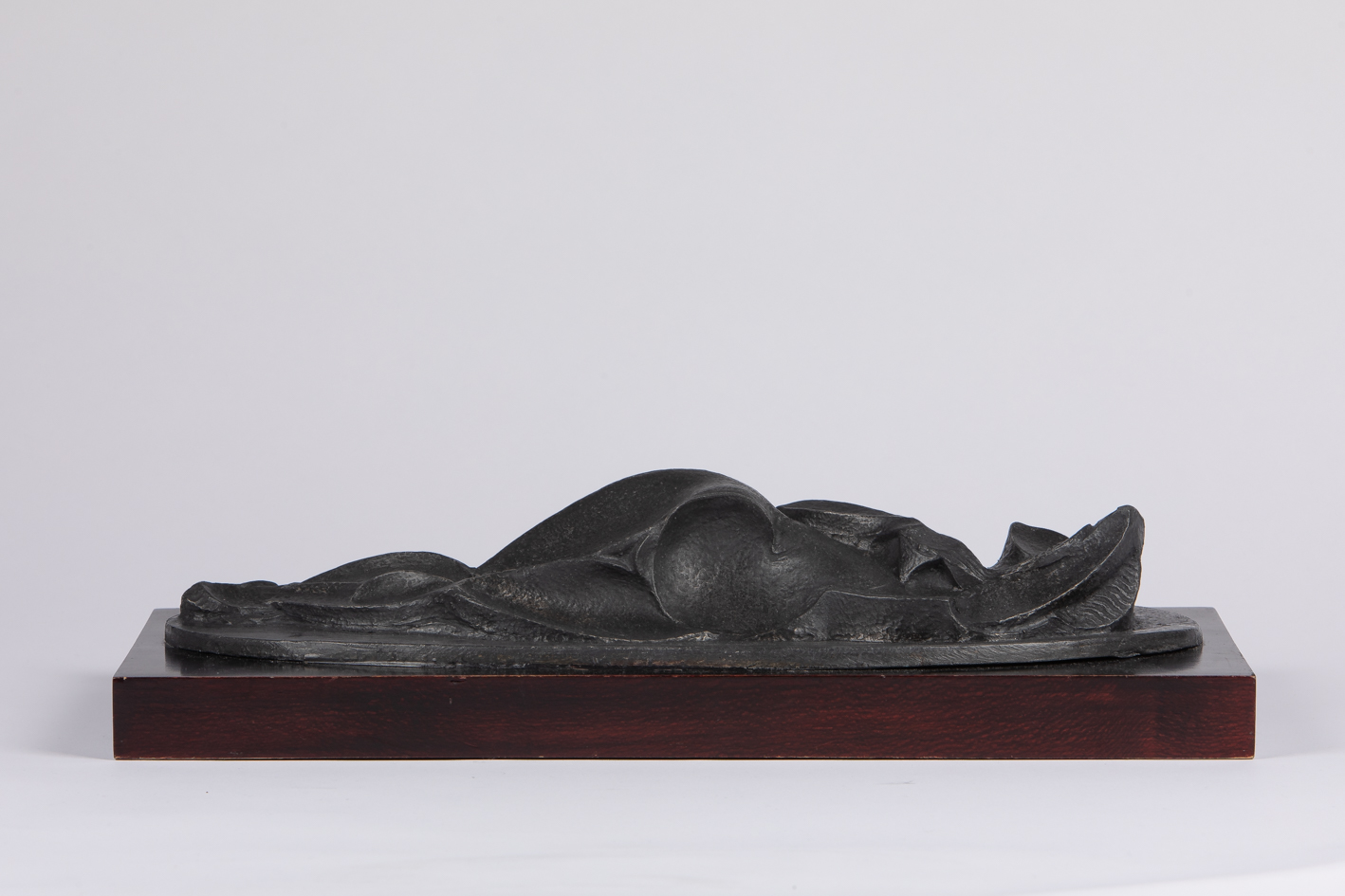
Pablo Gargallo
Woman Lying Down 1923
Hammered lead – unique piece
6 x 38,2 x 15,6 cm
Provenance
- The Artist’s Studio
- France, The Artist’s Family
Bibliography
- 1970 EXPOSITION : Gargallo, Paris, musée Rodin, 1970, cat.38 (bronze, collection Anguera Gargallo)
- 1973 COURTHION : Courthion, Pierre, Pablo Gargallo, catalogue raisonné par Pierrette Anguera-Gargallo, XXe Siècle, Paris, 1973, repr. n°78.
- 1979 ANGUERA [1]: Anguera, Jean, Pablo Gargallo, éditions Carmen Martinez, 1979 Paris.
- 1994 MUSEO PABLO GARGALLO : Ordóñez Fernández, Rafael, Museo Pablo Gargallo, ayuntamiento de Zaragoza, Electa, 1994, repr. p.118-119.
- 1998 CATALOGUE RAISONNÉ : Gargallo-Anguera, Pierrette, Pablo Gargallo, catalogue raisonné, préface de Philippe Dagen, l’Amateur, 1998, p.125, n°101.
- 2001 EXPOSITION : Pablo Gargallo, Monnaie de Paris, 3 avril – 10 juin 2001, repr. p.35.
- 2004 EXPOSITION : Pablo Gargallo, Institut Valencia d’Art Modern, Valencia, 29 janvier- 2 mai 2004, Centre Le Bellevue, salles Les Rhunes et les Vagues, Biarritz, 25 juin-3 octobre 2004, repr. p197.
- 2004 MUSEO PABLO GARGALLO : Ordóñez Fernández, Rafael, Museo Pablo Gargallo, ayuntamiento de Zaragoza, 2004, repr. p.155 (le bronze du musée).
- 2018 CASTRES : Gargallo, le vide est plénitude, Augé, Jean-Louis, sous la direction de, Castres, musée Goya, musée d’art hispanique, 29 juin – 28 octobre 2018, repr.p.84.
Exhibitions of the lead
- 1924 BARCELONE, Les Arts i els Artistes, Galerías Dalmau, May-June.
- 1947 PARIS, Rétrospective Gargallo, Arcades des jardins du Petit Palais, 9-24 May.
- 1966 DUISBOURG, Gargallo, Wilhem-Lehmbruck Museum, 19 November-31 December, n°31.
- 1981-1982 MADRID ZARAGOZA, Gargallo Exposición del Centenario, Palacio de Cristal, 20 octobre-26 novembre, La Lonja, 7 December-10 January, n°93.
- 1991 MADRID, Gargallo, La nueva edad de los metales, Fundación Cultural Mapfre Vida, 11 avril-19 mai, n°19.
- 2001 PARIS, Pablo Gargallo, La Monnaie, 3 April-10 June.
- 2004 VALENCIA-BIARRITZ, Pablo Gargallo, Institut Valencia d’Art Modern, 29 January- 2 May 2004, Centre Le Bellevue, salles Les Rhunes et les Vagues, Biarritz, 25 June-3 October 2004.
- 2018 CASTRES : Gargallo, le vide est plénitude, Castres, musée Goya, musée d’art hispanique, 29 June – 28 October 2018.
Exhibitions of the bronze
- 1970 PARIS, Gargallo, musée Rodin, 23 April-8 June, cat.38.
- 1971 MADRID, Gargallo, Museo Español de Arte Contemporáneo, 23 October-5 December, n°32
- 1974 TOKYO OSAKA, Le cubisme et la sculpture, Contemporary Sculpture Center, 19 September-9 October puis 27 November-14 December, n°15.
- 1977 PARIS, Trois sculpteurs des années 30. Gargallo, Csaky, Lambert-Rucki, musée Bourdelle, 1 June-30 September, n°7.
- 1978 MONT-DE-MARSAN, Cinq sculpteurs catalans. Fenosa-Gargallo-González-Manolo-Picasso, musée Despiau-Wlérick, July-August, n°17.
- 1980-1981 PARIS, Pablo Gargallo, musée d’art moderne de la ville, 18 December-1er March, n°52 (le bronze du musée d’art moderne de la ville de Paris).
- 1981 BARCELONE, Gargallo Exposició del Centenari, Gargallo, Palau de la Virreina, 1 April-24 May, n°62
- 1981 LISBONNE, Gargallo, Fondation Calouste Gulbekian, June-July, n°51.
- 1986 PARIS, De Montparnasse à Montsouris, mairie du XIVe, 5-28 April then at the musée Carnavalet, 12 July-5 October, n°298.
- 1992-1993 PALMA DE MAJORQUE, Homenaje a Joan Miró, Fundació Pilar y Juan Miró, December-February.
“Thus, starting from the circle, the spiral, the volute, the whirling of the mind, Pablo Gargallo, with warm authority, throws his design into form, guides it, brings it forth, leaving the viewer the pleasure of being enchanted by the discovery.”[2]
In the early 1920s, after more than a decade of experimenting with copper and iron plaques, a turning point occurred in Gargallo's work. He embraced a new material, lead plaque, which inspired him to develop a new mode of expression: treating volumes through hollows.
According to Jean Anguera, the artist's grandson and a sculptor himself, the original idea of inverting the representation of volumes certainly came to him in 1915-1916, when he created a series of bas-reliefs using the technique of repoussé metalwork. He hammered the metal on the back to create volume on the front.
The series of “in intaglio” works began in 1921 with Femme à l’ombrelle[3]. He then quickly transposed the technique into modeling and created several terracotta models that would be cast in bronze, such as Petit marin à la pipe (1922)[4]and Maternité en creux (1922)[5]. In total, Gargallo created six “in intaglio” models. Femme étendue en creux dates from 1923 and is the last.
This experimental idea of treating convex volume with concave forms demonstrates Gargallo's free and adventurous creative spirit. The plastic effect is not only effective, but also stimulates the viewer's imagination, who must recreate the forms in their mind. This is particularly striking when he depicts the Maternité en creux, a theme that essentially inspires full volume! With these hollow forms, a new play of light appears: "The convex relief is made up of sliding, fleeting buildings of shadow and light, with distorting reflections because it always receives several rays of light. The concave is clear, without reflection, with extraordinary subtleties in chiaroscuro, and retains all the rays of light it receives, unifying them. The flat surface is constructive, smooth, and immobile. This is where sculpture owes a debt to architecture,"[6]explains the sculptor, who also photographed his Femme étendue en creux[7] himself (see illustration below), illustrating his point with talent.
In Femme étendue en creux, thin, malleable lead plaques are cut, hollowed out, and then welded together in a sophisticated interplay of lines and shapes, synthetically describing the complexity of the morphology of a female body lying down in a twisted position, legs together, arms folded across the chest and around the head. The protruding lines that delineate the shapes draw the pattern in space with a sharp stroke. But these lines are all curved and describe volutes evoking feminine sensuality. The pose is open, voluptuous.
Gargallo had already depicted this pose in his 1903 ink drawing Nu étendu[8], then again in a similar pose in the small terracotta sculpture Jeune faunesse étendue[9] from 1906. Gargallo regularly explored the reclining nude in various artistic media, particularly in the 1930s. Each time, he presents sensual poses, as in the large pastel drawing La Dormeuse (1932), or in Petite bacchante étendue[10], a sculpture in copper also treated with hollow volume. Finally, a drawing of Nu étendu sur un lit[11] executed in 1930 completes this series of nudes in lascivious and abandoned poses.
This hammered lead sculpture is a unique work.
It is the original that was used to create a bronze edition.
The edition comprises seven numbered bronzes, three artist's proofs, a non-commercial bronze no. 1/1, a bronze for the Galleria d'Arte Moderna in Milan, a bronze for the Museo Reina Sofia in Madrid, and a bronze for the Museo Pablo Gargallo in Zaragoza.
Four bronzes are located in museums:
-Paris, Musée d'Art Moderne de la Ville, bronze no. 6/7, inv. AMS 547, purchased in 1976.
-Madrid, Museo Nacional Centro de Arte Reina Sofia, bronze “Museo Reina Sofia,” inv. AD03644, donated by Pierrette Anguera in 2004.
-Zaragoza, Museo Pablo Gargallo, bronze “Museo Pablo Gargallo”.
-Milan, Galleria d'Arte Moderna, bronze “HC”.
[1] 1979 ANGUERA, p.89
[2] Pierre Courthion in. 1973 COURTHION, p.7-8.
[3] 1998 CATALOGUE RAISONNÉ, n°93 : Femme à l’ombrelle, around 1921, lead, unlocated.
[4] 1998 CATALOGUE RAISONNÉ, n°99 : Petit marin à la pipe, 1922, bronze, 20 x 17 x 11,7 cm, inheritance Gargallo.
[5] Maternité en creux, 1922, terracotta, 33 x 19,5 x 19 cm, Museu Nacional d’Art de Catalunya, inv.071473-000, Angel and Maria Ferrant donation.
[6] Gargallo cité in. 1979 ANGUERA, p.
[7] 1998 CATALOGUE RAISONNÉ, p.41.
[8] 2004 EXPOSITION, p.195 : Nu étendu, 1903, ink, 11,5 x 25 cm, artist’s family.
[9] 1998 CATALOGUE RAISONNÉ, n°28 : Petite faunesse étendue, 1906, terracotta, 4,5 x 14 x 5,8 cm.
[10] 2004 EXPOSITION, p.269 : Petite bacchante étendue, 1929, plaque de cuivre, 21,3 x 36 x 13,2 cm, private collection.
[11] 2004 EXPOSITION, p.302 : Nu étendu sur un lit, 1930, ink and gouache, 23,4 x 34 cm, musée d’art moderne de la ville de Paris, inv. AMD810.