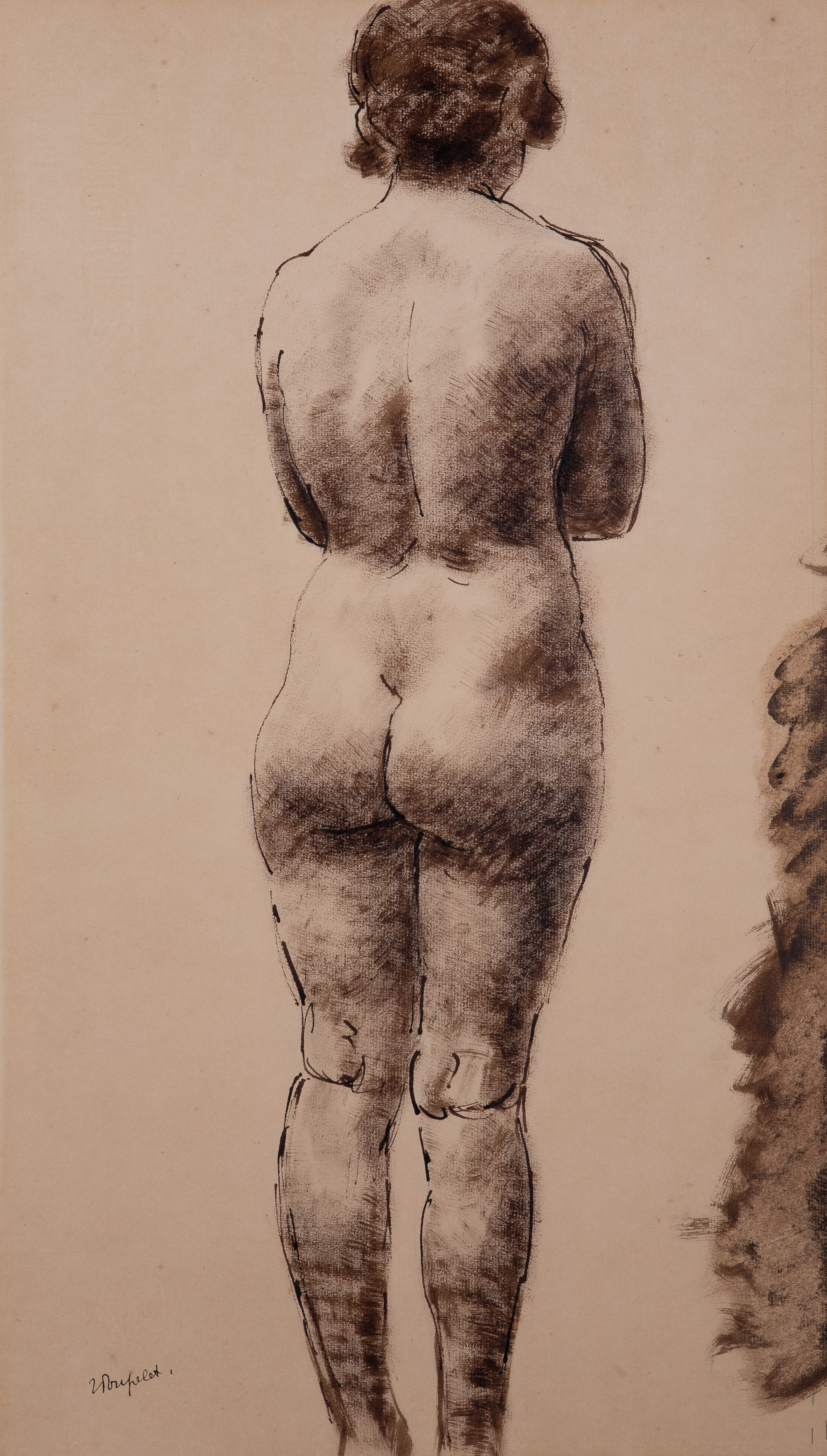
Jane Poupelet
Female Nude Back View
Pen and walnut ink wash
Signed : J Poupelet
H. 61 ; L. 34,5 cm
Provenance
- France, artist’s family
- France, Julien Saraben collection (1892-1979), curator at the musée du Périgord from 1942 to 1957
- France, Jacques Saraben collection, inheritence
Bibliography
- 1930 KUNSTLER: Kunstler, Charles, Jane Poupelet, Paris, Éditions G. Crès et Cie, 1930.
- 2003 DUMAINE : Dumaine, Sylvie, Les dessins de la statuaire Jane Poupelet (1874-1932), collection de dessins déposée à Roubaix, La Piscine, musée d’art et d’Industrie-André Diligent, mémoire de maîtrise, sous la direction de Frédéric Chappey, Université de Lille III, 2 tomes, 2003.
- 2005 CATALOGUE : Roubaix, La Piscine-musée d’Art et d’Industrie André Diligent, Jane Poupelet 1874-1932 « la beauté dans la simplicité », Éditions Gallimard, 2005.
“Since Renoir, no one has captured, as she has, the sensual charm of women, the smoothness of blossoming flesh, the firmness of muscles in action, the relaxation of muscles at rest; no one has suggested, as she has, with a few strokes of the pen or a few drops of ink, a complex joint such as that of a foot or a knee.”[1]
Jane Poupelet began drawing as a child. In 1882 at the age of 8, she was sent to Bordeaux to live with an "old spinster"[2] who instructed her in the art of drawing for more than ten years. Her efforts were rewarded in 1892 when she obtained a "certificate of ability" to teach drawing in schools. The same year, she enrolled in the local school for fine and decorative arts. In addition to being the first woman admitted to that school, she was also, with five other women, the first to be allowed to take courses in anatomy and to be present at dissections at the medical school in Bordeaux. In 1895, her studies gained her the governmental diploma of Professor of drawing. With this second diploma in her pocket, Poupelet, still quite young, went to Paris; she arrived sometime between the end of 1896 and the beginning of 1897. There, she drew the city's monuments and attractions, filling up many sketchbooks. Yet what would capture her interest the most at the beginning of the 20th century, in addition to animals, was the female form.
The drawing presented here depicts a naked woman, seen from behind. The model stands upright, arched, with her arms crossed under her chest and her neck rounded by the slight forward movement of her head. Standing vertically, across the entire height of the sheet, this female body is powerfully anchored to the ground. The framing is so tight on the figure that the extremities, feet and head, are cut off. The pose is monolithic, with the arms folded across the chest and the legs pressed tightly together.
Although minimalist in composition, the Female Nude Back View features a walnut stain relegated to the right edge of the drawing. This oddity raises questions: “Is it a gesture, a tic, a ritual, a warm-up preceding the concentration inherent in the brilliance of the execution?”[3]. These stains can be found in other female nudes by Jane Poupelet.
A drawing very similar to Female Nude Back View is kept at the Musée National d'Art Moderne in Paris:Nu de dos tenant un bâton was donated by the artist's family in 1934 (inv. AM 1176 D).
Jane Poupelet captures ‘beauty in simplicity’, to quote Rodin. In one of her rare handwritten notes, she confides: "Art consists of rendering beauty and ugliness. That is its raison d'être... beauty in art is the splendor of truth. Beauty is not true, it is not one, it varies according to each individual. "[4]. This raw and authentic vision is palpable in our Female Nude Back View, which makes no attempt to seduce. The model's massive build and the raw realism of the flesh testify to the artist's desire to render the bodies of her women truthfully, without artifice or grace.
Jane Poupelet's drawings are rarely preparatory studies for sculpture, but rather autonomous works that nevertheless display all the characteristics of statuary art. Our nude is treated with a very three-dimensional vision of forms, specific to ‘sculptor's drawing’. The silhouette is outlined with a fine pen stroke, while the modelling is constructed through dense hatching and shading with walnut ink, a natural dye that the artist particularly appreciated for its local, rustic character and ease of supply. The light brings out all the nuances of this architecture, enhancing the prominent parts of the body with subtle touches.
[1]1930 KUNSTLER, p. 10.
[2] 2005 CATALOGUE, p. 13.
[3] 2003 CATALOGUE, p. 82.
[4] 2005 CATALOGUE, p. 83.