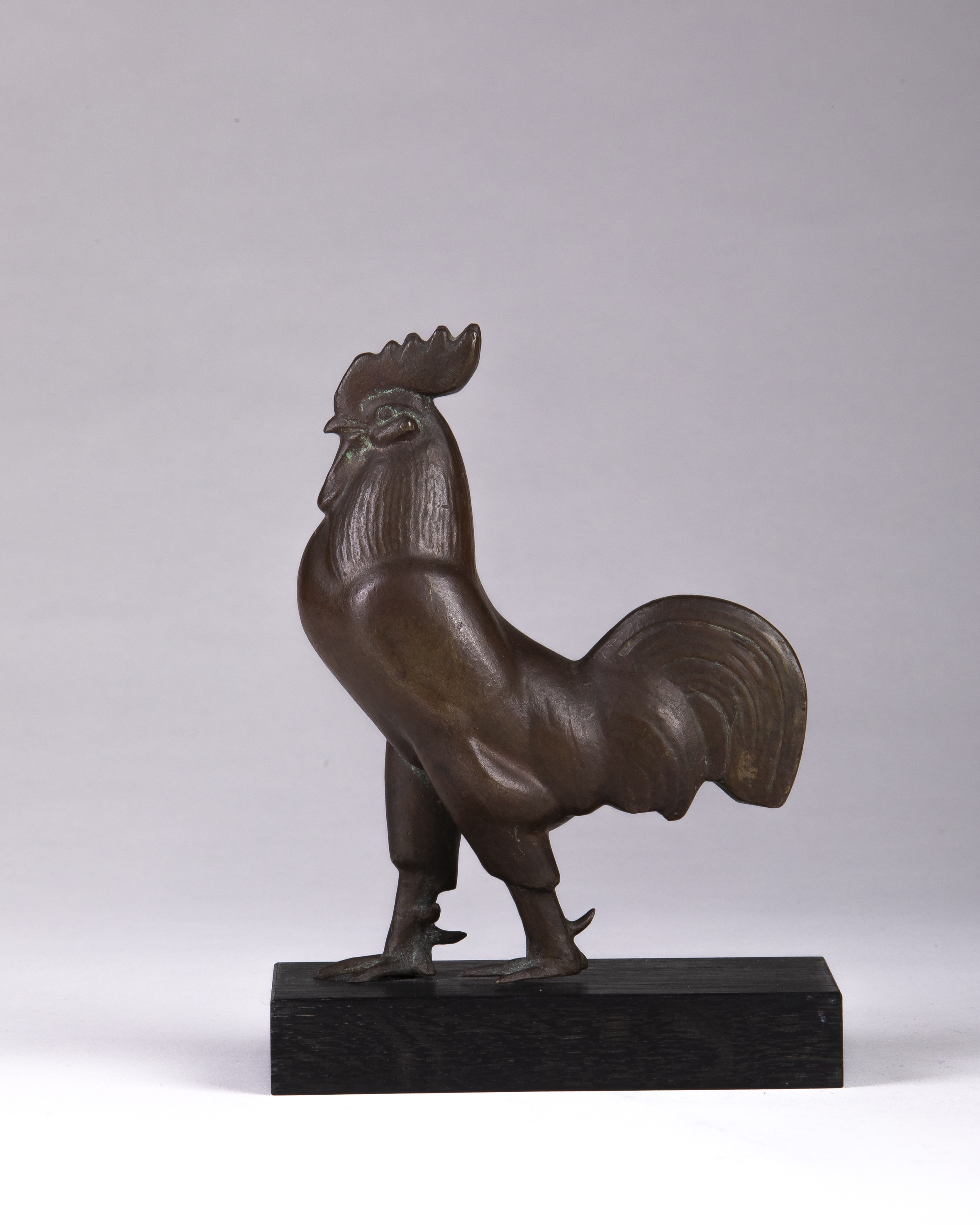
Jane Poupelet
Walking Rooster or Chantecler 1902 ?-1909
Bronze with brown patina
Sand cast without foundry mark
Unsigned
H. 15,2 x L. 11,1 x P. 5 cm
Provenance
- United States, private collection
Selective bibliography
- 1910 AGEORGES : Joseph Ageorges, « Les petites bêtes de Mlle Poupelet », in Le Mois littéraire et pittoresque, 1910, p. 407, repr.
- 1913 GUILLEMOT : Maurice Guillemot, « Jane Poupelet », in Art et Décoration, n°12, décembre 1913, p. 51, repr.
- 1930 KUNSTLER : Charles Kunstler, Jane Poupelet, Paris, Éditions G. Crès & Cie, 1930, n°1, NP (p. 17), repr.
- 1973 WAPLER : Vincent-Fabian Wapler, Jane Poupelet, sculpteur, 1878-1932, mémoire de maîtrise sous la direction de M. Souchal, Lille, Université Lille III, UFR d’Histoire de l’Art, 1973, n°42, p. 169-170, repr.
- 2005 RIVIÈRE : Anne Rivière, Jane Poupelet 1874-1932. « La beauté dans la simplicité », catalogue d’exposition [Roubaix, La Piscine – musée d’art et industrie André Diligent, 15 octobre 2005 – 15 janvier 2006, Bordeaux, musée des beaux-arts, 24 février – 4 juin 2006, Mont-de-Marsan, musée Despiau-Wlérick, 24 juin – 2 octobre 2006], Paris, Éditions Gallimard, 2005, n°124, 125, p. 105, repr.
- 2017 RIVIÈRE : Anne Rivière, Dictionnaire des sculptrices, Paris, mare & martin, 2017.
“Will I ever cease to marvel at animals?”[1]
Trained at the Bordeaux School of Fine Arts, Jane Poupelet has a thorough knowledge of the works of the masters of centuries past, whether European, Japanese, or Egyptian… After moving to the capital around 1896-1897, among her contemporaries, she frequently socialized with Lucien Schnegg (1864-1909) and his friends. Becoming a member of the “Bande à Schnegg” (“Schnegg’s gang”), she and Charles Despiau (1874-1946) became the leading ambassadors of a refined style with smooth forms, inherited from the Greco-Roman tradition and breaking with the turbulent art of Auguste Rodin (1840-1917).
From an early age, Jane Poupelet observed the various animals that populated her family’s estate in the Dordogne region of France and began to develop a bestiary consisting of domestic and farm animals. She sketches cats, chickens, and roosters, cows, dinkeys and rabbits from life. She observes the animal as it moves around and tracks the posture that interests her. During the year 1906, she moved away from naturalism and anecdotalism, transforming the immediacy of movement into a solemn and timeless form[2]. This work based on nature allows her to create sculpted figures with extremely synthetic and accurate forms. “I make a clay sketch in front of the animal or model. Then I work on the plaster; I add, remove, simplify…”, says the artist[3].
The king of the farmyard is depicted here in all his splendor and majesty; he stands tall and proud. Poupelet’s style is recognizable in these synthetized, simplified lines and curves However, the animal is perfectly characterized by its attributes: the crest, the wattles, and even the spurs on its legs. Its tail is treated as a striated arc, in a very decorative manner.
More than just a farm animal, it is the very symbol of France that is represented here, with a strong character and an extravagant personality: “this “Rooster” is remarkable for the attitude that the Artist has given it, revealing a temperament that is, if not ironic, at least witty, capable of concisely suggesting the idea of majesty, both undulating and stilted, that everyone expects to find in the representation of a rooster.”[4]
This humanization, bordering on caricature, was already observed by journalist and writer Joseph Ageorges in 1910. In addition to comparing Poupelet’s Walking Rooster to the works of the greatest caricaturists of the 19th century, such as Jean-Jacques Grandville (1803-1847) and Honoré Daumier (1808-1879), he imagines a life, career, and clothing style for him. He even goes so far as to name him Chantecler, in reference to Edmond de Rostand’s play of the same name, whose main character is none other than a rooster : “[…] Between the two stood Sir Chantecler – perfectly, - but a Chantecler who was not educated at the Conservatory, like Rostand’s, a Chantecler who does not give speeches at popular universities, a brave lad of Chantecler, wealthy and retired from business after making his fortune, a provincial Chantecler, a kind of gentleman bourgeois in baggy breeches, broad and sturdy, a rooster who rises after the sun, but who is no less proud of it. […] Miss Poupelet’s rooster, but I’d like it on the bell tower of my parish church! Looking at these little creatures, I thought to myself that I hadn’t seen anything like them since La Fontaine. […] These are good animals from our region, good animals, animals like humans.”[5]
The Walking Rooster or Chantecler was exhibited for the first time in 1909 at the Salon de La Libre Esthétique in Brussels[6], then in the same year at the Salon d’Automne in Paris[7]. The model was then exhibited in 1912, at the IIIe exposition quinquennale des Prix du Salon et Boursiers de voyage, and in March 1922, at the Exposition de la Société des Artistes Animaliers. The work was also featured in two. Major retrospectives of the sculptor’s work at the Galerie Bernier in 1928 and 1930. The catalogue for the first exhibition dates the model to 1902[8], while the catalogue of the latter indicates that twelve copies of the Walking Rooster were cast. François Fosca (1881-1980), in his review of the 1930 exhibition, also considers the Walking Rooster to be one of the sculptor’s essential works: “As for the sculptures, I will mention only two, which think sum up very well the two sides of Jane Poupelet’s great talent: First, the nude woman with her arms raised, a work of remarkable fullness and sobriety, and the little rooster, witty and accurate.”[9]
The rooster occupies an important place in Jane Poupelet’s bestiary. The artist sketched it a lot from life[10], as in this Rooster and Two Hens, held at the National Museum of Modern Art in Paris (n°inv. AM 1150 D) or these Roosters, held at the Metropolitan Museum in New York (n°inv. 58.18.1). In sculpture, two other models of Roosters can be found in the artist’s work: the first, which is one of the wooden toys that the sculptor made during the First World War for war orphans, is simply a transposition of her Chantecler in wood; and a second, a radically different one created around 1930, whose features are much more stylized, with more rounded shapes, so much so that one might wonder whether it is a rooster or a turkey[11].
However, Jane Poupelet is not the only one to have taken an interest in the figure of the rooster. It should be noted that the sculptor founded, together with François Pompon (1855-1932), the “Group of the XII” in 1931, bringing together several animal artists under the sale banner[12]. The Group’s first exhibition the following year was a success: “It has been a long time since we have seen a group of animal sculptors and painters of such caliber and quality as that currently assembled, until May 3, at the Hôtel J.E. Ruhlmann, 27, rue de Lisbonne, by the recently formed “Group of Twelve”.”[13]Pompon, as it happens, exhibits “a magnificent, powerful fighting cock”[14]. The latter worked particularly on the representation of the rooster in sculpture as there are more than fifteen models and variations of the animal in his sculpted work. One example is his Weathercock[15] (1908-1932), whose tail, rendered in arcs, bears a strong resemblance to our model, demonstrating the mutual influence between the two artists. Another sculptor exhibiting with the Group was Anne-Marie Profillet (1898-1939), who also took an interest in the motif of the Fighting Cock[16] (1927), in a more realistic vein than her two colleagues.
To this day, three casts of the Walking Rooster or Chantecler have been identified, in addition to the one presented here:
- a first bronze, with black patina, is held in a private collection[17] ;
- a second bronze, with golden patina, entered the collections of the National Museum of Modern Art in Paris, following a donation by the artist’s sisters to the State in 1934. The work has been on loan to the Cambrai Museum since 1994 (n°inv. AM 576 S) ;
- finally, a third bronze, with black patina and shades of green, entered the collections of the Art Institute of Chicago following the bequest of George F. Porter in 1927 (n°inv. 1927.368).
[1] “M’émerveillerai-je jamais assez des bêtes”: Colette, in her Dialogues de Bêtes (Animal Dialogues) published in 1904 (quoted in Pierrette Bourdanton, « Pour un hommage au grand sculpteur Jane Poupelet », in Revue des artistes français, n°9, janvier 1982, p. 8).
[2] 2005 RIVIÈRE, p. 37.
[3] 2005 RIVIÈRE, p. 40.
[4] 1973 WAPLER, p. 170.
[5] 1910 AGEORGES, p. 407.
[6] La Libre Esthétique. Catalogue de la seizième Exposition à Bruxelles du 7 mars au 12 avril 1909, Bruxelles, Impr. Veuve Monnom, 1909, n°207 (bronze).
[7] Société du Salon d’Automne, Catalogue des Ouvrages de Peinture, Sculpture, Dessin, Gravure, Architecture et Art décoratif exposés au Grand Palais des Champs-Élysées Du 1er Octobre au 8 Novembre 1909, Paris, Société anonyme de l’imprimerie Kugelmann, 1909, n°1428, p. 165 (bronze).
[8] However, the date of 1902 seems to be questioned by Anne Rivière in the exhibition catalogue dedicated to the sculptor. Indeed, the model was not exhibited until 1909; moreover, a photograph showing Jane Poupelet chiseling a plaster rooster, precisely our model, is also dated around 1909. See 2005 RIVIÈRE, p. 40 and p. 105.
[9] François Fosca, « Chroniques. Jane Poupelet (Galerie Bernier) », in L’Amour de l’Art, 1930, p. 357.
[10] 2005 RIVIÈRE, n°233 à 238, p. 125-126.
[11] An example of this Rooster or Turkey is held at the National Museum of Modern Art in Paris (n°inv. AM 577 S).
[12] The group gathers the following painters and sculptors: Charles Artus (1897-1978), Gaston Chopard (1883-1942), Georges Guyot (1885-1972), Georges Hilbert (1900-1982), Adrienne Jouclard (1882-1972), Paul Jouve (1878-1972), Marcel Lémar (1892-1941), André Margat (1903-1997), François Pompon, Jane Poupelet, Anne-Marie Profillet (1898-1939), and Jean-Claude Baugnies de Saint-Marceaux (1902-1979).
[13] Anonyme, « Le « Groupe des Douze » rue de Lisbonne », in Le Journal, 30 avril 1932, p. 4.
[14] Ibid.
[15] Catherine Chevillot, Liliane Colas, Anne Pingeot, François Pompon. 1855-1933, Paris, Gallimard / Electa – Réunion des musées nationaux, 1994, n°57A, p. 195, repr.
[16] A cast of this Fighting Cock, held at the National Museum of Modern Art in Paris, has been on loan to La Piscine – musée d’art et d’industrie André Diligent since 2000 (n°inv. AM 853 S).
[17] 2005 RIVIÈRE, n°124, p. 105.