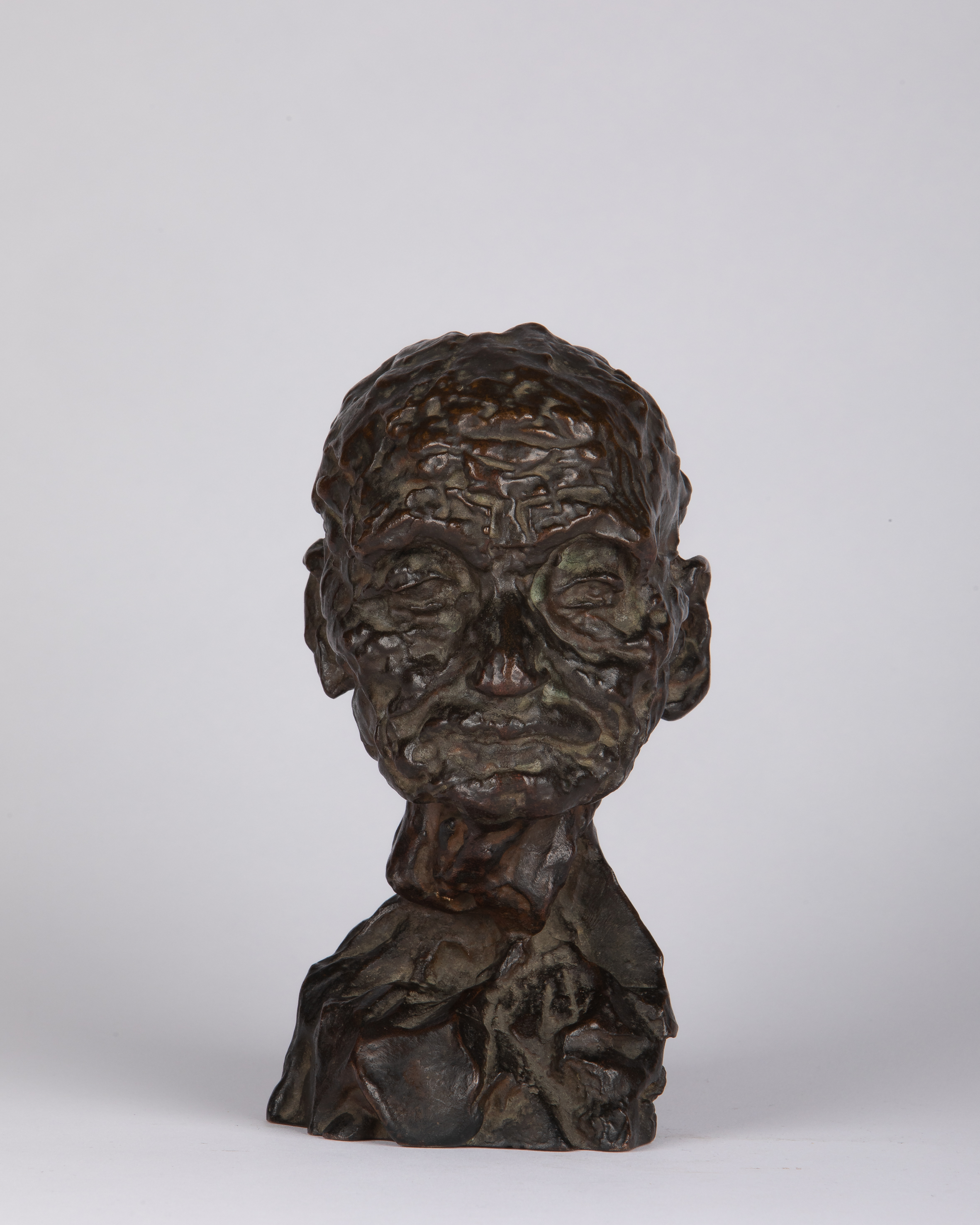
Camille Claudel
Head of an Old Man, study for the central character of Maturity c.1894
Bronze proof with brown patina, n°2
Sand casting, certainly executed before 1920
Signed (on the base, bottom right): C. Claudel
Eugène Blot’s stamp (under the signature): EUG.BLOT / PARIS
Numbering (to the right of the stamp): 2
H. 18 ; L. 9 x ; P. 9 cm
Provenance
- Paris, Henri Désiré Gauquié (1858-1927), probably acquired from the artist before 1920;
- By descent;
- Paris, Christie’s, Impressionist & Modern Art Sale, March 29, 2019, lot 275;
- Paris, Private collection.
This small, highly expressive Head of an Old Man is a study for the central character in L'Âge mûr (Maturity), one of the sculptor's major works. Thanks to numerous sources, it has been possible to establish the long and complex creative process behind this sculpture, which is composed of three figures.
The Genesis of L’Âge mûr
The first mentions of Camille Claudel working on this sculpted group date back to 1893. An event occurred that turned the young woman's life and career upside down: she ended her relationship with Auguste Rodin (1840-1917). At the end of that same year, in December, the artist sent a letter to her brother, the playwright and diplomat Paul Claudel (1868-1955), then vice-consul in New York. This letter highlights the imagination and creativity that drove the sculptor, who herself emphad: “I take great pleasure in working.”[1] It contains no less than six sculpture projects, accompanied by sketches, including this “group of three [...] in full width.” She concludes by stating: “You see that it no longer looks like Rodin at all.”[2] She was then deeply concerned with making a stylistic break with Rodin's art, as critics constantly criticized her for being too close to him.
In this first known sketch (fig. 1), Camille Claudel already notes the final composition of her group, with the three figures arranged around a large diagonal: two figures are standing, one pulling the other to the left, while to their right, a third figure, kneeling, raises her arms in their direction. The only detail that the artist ultimately decided not to include was the “leaning tree that would express destiny.”[3] The following year, in 1894, studies for the three figures in her composition began to appear: the Head of the Implorer, the Head of an Old Woman, and the Head of an Old Man, studied here.
In 1895, Fine Arts Inspector Armand Silvestre (1837-1901) visited Camille Claudel's studio. Originally there to commission a bust of Gaston d'Orléans, he noted in his report that Camille Claudel had produced an initial “plaster model” of her group: “The artist would much prefer that the State commission her to produce this work, which she intends to make in marble for 5,000 francs. Without giving her any hope on this subject, I promised to submit her request to you. It is truly a very noble and sophisticated work for a woman.” [4]
This first plaster version of L'Âge mûr, now kept at the Musée Rodin, differs from the sketch reproduced above: its composition is frontal and pyramidal. The man, in the center, is unbalanced between two women. On the right, the young woman kneels and grabs him by the shoulder; on the left, he leans on the older woman, who is about to wrap her arms around his waist. What is striking about this first version is the anatomical exaggeration, particularly in the length of the male figure's arms. These two women, who are fighting over the same man, make him look like a disjointed puppet, which greatly increases the dramatic power of the group. Convinced of its quality, the Ministry officially commissioned the final version of this group from the artist on July 25, 1895.
Camille Claudel then reworked her piece and, when she finished it at the end of 1898, presented Silvestre with the second version that we know today. The following year, the group was exhibited for the first time at the Salon de la Société nationale des Beaux-Arts under the title L’âge mûr (groupe fantastique, plâtre)[5]. Critics such as Yvanhoé Rambosson (1872-1943) praised the powerful expressiveness and beauty of movement in this sculpture: “Mademoiselle Claudel's L'Âge mûr is a kind of masterpiece [...]. Since Carpeaux, nothing more dynamic than L'Âge mûr has been created. The personification of Youth kneels, desperately reaching out her arms to the man who is moving away from her towards Old Age which is already regretfully drawing and guiding him, as he falls towards her. Nothing could be more dramatic or more vivid in the realm of fantasy because of how well this man works and how expressive these two women are in their movement.”[6]
However, the work was poorly received following this exhibition. The autobiographical nature attributed to the work led some contemporaries and visitors to the Salon to interpret the composition as an allegory featuring Rodin, Rose Beuret (1844-1917), his lifelong companion, and Claudel herself in the guise of L'Implorante. Was this not what prompted Paul Claudel to say a few years later: “This naked girl is my sister! My sister Camille. Implorante, humiliated on her knees, this superb, proud woman, this is how she represented herself. Implorante, humiliated, on her knees and naked! It's all over! That is what she has left us to look at forever! And do you know what? What is being torn from her, at this very moment, before your eyes, is her soul! It is her soul, her genius, her reason, her beauty, her life, her very name.”[7]
Thus, this autobiographical aspect, which seemed to cause discomfort, had a direct consequence: in 1900, the presentation of L'Âge mûr at the World's Fair was refused. Furthermore, the commission for the bronze group was ultimately canceled without any reason being given. Despite several attempts by the artist to follow up with the Fine Arts administration, as well as those of many of his supporters over a period of nearly 10 years, the bronze was ultimately never cast on behalf of the State.
The Head of an Old Man
As we have said, this small Head of an Old Man is part of a series of preliminary studies for the group sculpture L'Âge mûr. What is immediately apparent when observing this work is the extremely pronounced modeling of the withered skin. Camille Claudel plays with the solids and voids of her sculpture, but also with light and shadow: the eye sockets are hollowed out, the wrinkles pronounced, the lips pursed. The prominent Adam's apple and elongated neck make this Head appear larger and more majestic, in the same way and with the same originality with which Claudel treated her Bust of Auguste Rodin, whose beard becomes the base of the sculpture.
This expressionist work is a desperately exaggerated portrait of an elderly man, who is little more than skin and bones. His sickly thinness accentuates his features. What's more, the man's gaze is lost in the void and he seems to be deep in introspection. More than just a portrait, this Head is an allegory of Old Age. The viewer is confronted with their own mortality and contemplates their own finitude: it is a true memento mori. However, despite the fear, doubt, or suffering that one may feel when looking at this portrait, it is not without “great beauty.” On the contrary, as Rodin reminds us: “What is commonly called ugliness in nature can become great beauty in art. In the order of real things, we call ugly that which is deformed, that which is unhealthy, that which suggests the idea of disease, debility, and suffering, that which is contrary to regularity, the sign and condition of health and strength [...]. But when a great artist or writer takes hold of one or another of these forms of ugliness, they instantly transform it... with a wave of their magic wand, they turn it into beauty: it's alchemy, it's magic!”[8]
This Head of an Old Man, created around 1894, was produced in a studio environment marked by intense artistic rivalry, where exchanges between sculptors fostered mutual influences. Indeed, the previous year, Camille Claudel had presented Clotho at the Salon de la Société nationale des Beaux-Arts. The sculpture is a full-length portrait of an elderly woman with an emaciated body. Clotho is one of the three Fates in Greek mythology, who spin the thread of life. The sculptor embodies this aspect of the story by making this woman a completely disheveled figure, whose heavy, falling hair twists around her frail and thin body. Numerous comparisons have already been made with the models for La Misère by Jules Desbois (1851-1935) and Celle qui fut la Belle Heaulmière by Auguste Rodin, created during the same period. In fact, it would appear that Claudel, Desbois, and Rodin used the same Italian model for their sculptures: a certain Maria Caira.[9].
In any case, the theme of the aging body and the suffering it causes was a real concern for sculptors of that era. This theme became a pretext for existentialist, naturalist, and symbolist works. There is no doubt that Clotho influenced the creation of L'Âge mûr, especially since the latter was the subject of a marcottage[10], as we see her in the elderly figure surrounded by drapery, leading the aging man toward his grim fate.
Another interesting fact to note is that the model of the Head of an Old Woman (fig. 2), one of Claudel's first studies for her group, seems to have been incorporated without any modifications into the first version of L'Âge mûr (fig. 3), as well as into its second version (fig. 4). On the contrary, the Head of an Old Man (fig. 5) does not seem to have been retained by the sculptor, since the facial features of the central male figure are much softer (fig. 6 & 7) and much less pronounced than in the study we are presenting here.
Finally, old age has always been an obsessive theme for the sculptor. Indeed, it should be remembered that her very first work exhibited at the Salon in 1882, when Camille Claudel was not yet 18 years old, was a portrait of her maid, La Vieille Hélène. Similarly, other similar portraits can be found in her body of work: Vieux musicien aveugle, Tête de vieil aveugle chantant, and a series of portraits of old women created during stays in the Vosges and on the Isle of Wight between 1885 and 1886: Mennie-Jean, Femme de Gérardmer, A Quiet nap, Fisher Woman, and Old Granny[11].
Tissier, Rudier and Blot
Due to the cancellation of the commission by the State, if we are familiar with L'Âge mûr and the Head of an Old Man in bronze today, it is thanks to the private initiative of a collector: Captain Louis Tissier. He visited the 1899 Salon with the painter Léon Lhermitte (1844-1925), a close friend of Camille Claudel. The art lover fell in love with L'Âge mûr, which was on display in plaster at the time. He therefore commissioned a bronze cast of the single figure from L'Implorante, cast by Gruet [12].
Shortly thereafter, around 1901, the collector commissioned the sculptor to create a bronze version of the Head of an Old Man, which he had discovered in Claudel's studio. The casting was carried out by François Rudier, and to this day, the work remains in the possession of the collector's family. The correspondence between the artist and her patron provides information about the different stages and timing of the casting process for the creation of the first bronze of this model. Claudel wrote to Captain Tissier around January 10, 1902: "I would be delighted if you would give me a deposit on the small head you commissioned from me in bronze. It will be ready soon and well-cast, I assure you.”[13] On January 18, she informed Mr. Tissier that “[Her] little bronze head will be ready by the middle of next week, patinated and signed, and [she will be] very proud to know that it is in [his] possession.”[14]
Meanwhile, the patron inquired with his protégée to find out how much it would cost to cast the entire group of L'Âge mûr, as Captain Tissier recalls in a letter to the artist's brother in 1943: “Returning to France at the end of 1901, I saw Camille Claudel again and found the group L'Âge mûr in her studio. She told me that she had not wanted to deliver it to the State, which had acquired it, fearing that, if placed in the “Dépôt des Marbres”, that great sculpture cemetery on Rue de l'Université, the plaster would suffer great damage. I was seized by a desire to save the work from destruction by having it cast; I already had one of the figures. Unfortunately, the base modeled especially for it could not be adapted to the other part. [...] I had to find a founder. Rudier, whom your sister suggested, gave me a quote that my modest means did not allow me to accept.” [15] Once again, the artist's correspondence tells us that François Rudier estimated the cost of casting at 6,000 francs[16], which was too high for the captain's means. Claudel then reached an agreement with the foundrymen Thiébaut frères, Fumière, and Gavignot, who carried out the casting and were paid 2,800 francs[17] by the patron. This bronze is now kept in the collections of the Musée d’Orsay.
The story of the edition of the Head of an Old Man does not end there, as Camille Claudel's dealer, editioner, and friend Eugène Blot (1857-1938) “acquired the reproduction rights, probably in 1905.”[18] The model definitely appears in the list of Camille Claudel's works exhibited at the artist's third exhibition at the Galerie Eug. Blot in 1908, under the title Buste Vieil homme (study for La Jeunesse and l'Âge mûr)[19]. Blot then announced the publication of this model in “25 numbered proofs”. However, the model was undoubtedly already exhibited at Claudel's first exhibition at Blot in 1905, but under an erroneous title: “Buste vieille femme”. Similarly, the edition is indicated as “limited to 50 casts”, which may have been revised downward by the dealer three years later. In any case, we know of no other “old women” in the sculptor's body of work that were published by Blot, leading Catherine Chevillot to conclude that “it is in fact the same work.”[20]
The archives concerning Eugène Blot's 1937 transfer of his manufacturing rights to Maison Barbedienne (Leblanc-Barbedienne & Fils) do not mention the Head of an Old Man, so the exact number of casts produced for this model remains unknown to this day. Based on our current knowledge, only two bronzes have been identified to date: No. 1, held in the collections of the Camille Claudel Museum in Nogent-sur-Seine (inv. no. 2010.2.4); and No. 2, presented here. It is also important to note the particularly prestigious provenance of our work, as it was acquired during the artist's lifetime by the sculptor Henri Désiré Gauquié (1858-1927). The work was then kept in the sculptor's family, passed down through the generations, until it appeared on the art market in 2019.
The Head of an Old Man, study for the central character of L’Âge mûr, is a testament to the expressive power that Camille Claudel infused into her sculpture. Despite its small , this Head is a truly moving and stirring masterpiece, both in its sincerity and in the message it conveys.
[1] 2014 CORRESPONDANCE CAMILLE CLAUDEL, letter n°79, p. 102.
[2] Ibid.
[3] Ibid.
[4] Report by Armand Silvestre to the Minister of Public Instruction and Fine Arts, July 3, 1895, Paris, Archives nationales, F21 2162.
[5] Société nationale des Beaux-Arts, Catalogue Illustré du Salon de 1899, Paris, Ludovic Baschet éditeur, 1899, n°28, p. XLIX.
[6] Yvanhoé Rambosson, L’Art décoratif, juin 1899, transcribed in Danielle Arnoux, Camille Claudel. L’ironique sacrifice, Paris, EPEL, 2011 (1ère édition, 2001), p. 115.
[7] Paul Claudel, « Camille Claudel », in commissariat de Cécile Goldscheider, Camille Claudel, catalogue d’exposition [Paris, musée Rodin, novembre-décembre 1951], Paris, musée Rodin, 1951, p. 10-11.
[8] Véronique Mattiussi (edited by), Auguste Rodin. L’Art. Entretiens réunis par Paul Gsell, Paris, Musée Rodin, 2022, p. 54.
[9] Antoinette Le Normand-Romain, « Ostéologie de vieilles », in Camille Claudel et Rodin. La Rencontre de deux destins, catalogue d’exposition [Québec, musée national des beaux-arts, 26 mai – 11 septembre 2005, Detroit, Detroit Institute of Arts, 2 octobre 2005 – 5 février 2006, Martigny, Fondation Pierre Gianadda, 3 mars – 15 juin 2006], Paris, Hazan, 2005, p. 161-162.
[10] “Composing a new sculpted work by partially or totally reusing works already created by the artist. The sculptor fragments his own works and reintroduces them into a new work.” (Definition of “marcottage” in Marie-Thérèse Baudry (edited by), Sculpture. Méthode et vocabulaire, Paris, Éditions du Patrimoine-Imprimerie nationale, 2000 (1ère édition, 1978), p. 549).
[11] See from n°81 to 85 in 2001 RIVIÈRE-GAUDICHON-GHANASSIA, p. 193-195.
[12] See n°44.7 in 2001 RIVIÈRE-GAUDICHON-GHANASSIA, p. 139. The work is now kept in a private collection.
[13] 2014 CORRESPONDANCE CAMILLE CLAUDEL, letter n°210, p. 202.
[14] 2014 CORRESPONDANCE CAMILLE CLAUDEL, letter n°212, p. 204.
[15] L.A.S., Louis Tissier to Paul Claudel, 31 août 1943, NAF 28255, Paris, Bibliothèque nationale de France, transcribed in 2001 RIVIÈRE-GAUDICHON-GHANASSIA, p. 150.
[16] 2014 CORRESPONDANCE CAMILLE CLAUDEL, letter n°211, p. 203.
[17] 2014 CORRESPONDANCE CAMILLE CLAUDEL, note 2, p. 206.
[18] 2017 CATALOGUE MUSÉE NOGENT-SUR-SEINE, p. 329.
[19] 1908 CATALOGUE EXPOSITION GALERIE PARIS, n°6.
[20] Catherine Chevillot, « « Prenez la main que je vous tends » Eugène Blot, du milieu des fabricants de bronze à celui des galeries », in Camille Claudel et Rodin. La Rencontre de deux destins, op. cit., p. 273.