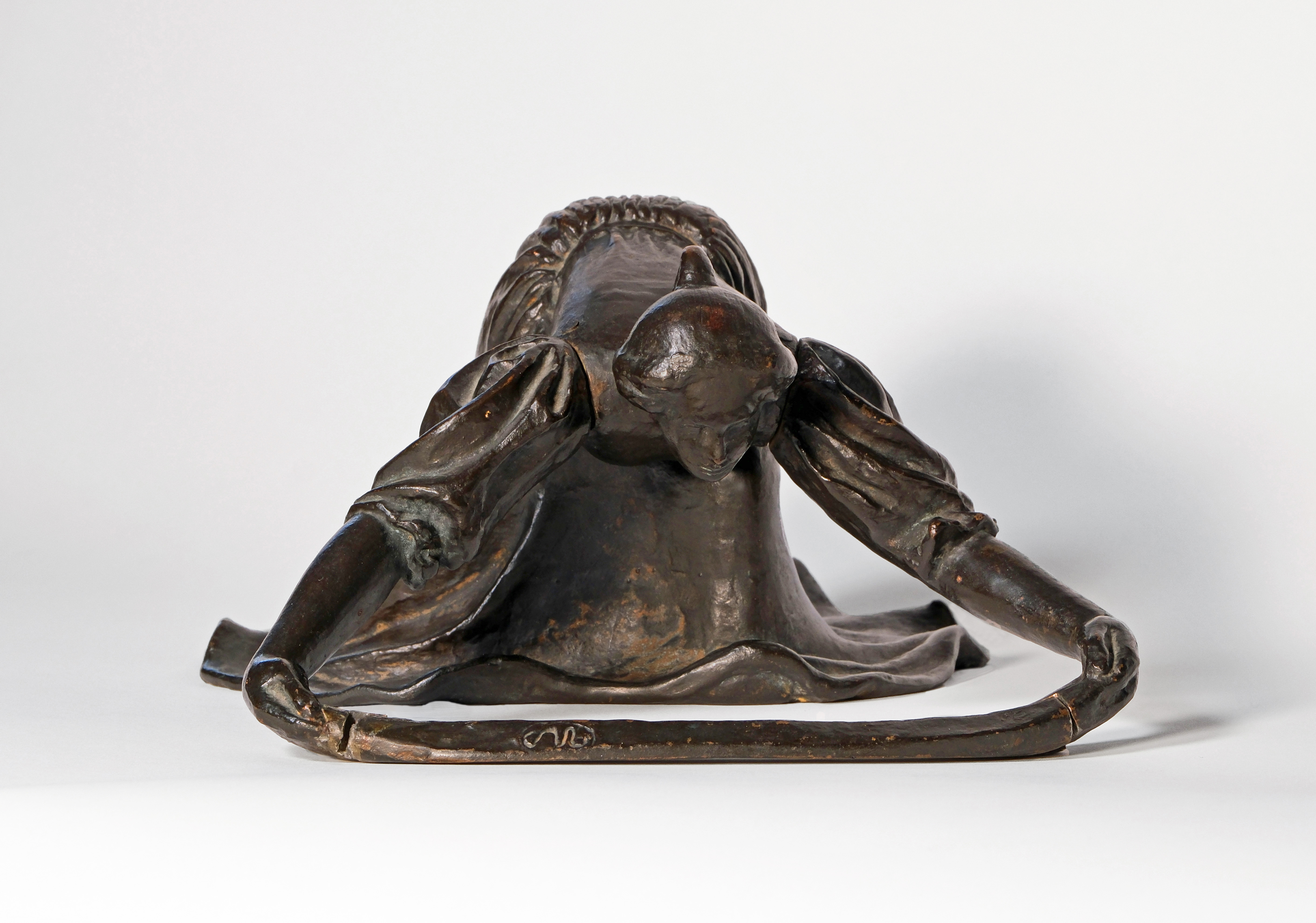
Aristide Maillol
Door-knocker, Woman Spreading Out Her Washing (The Washerwoman) 1902 ou avant
Bronze
Vollard edition begun in 1902
Model no.2, « Marteau de porte : femme étendant linge », Catalogue of the sculptures by Maillol produced in editions by Ambroise Vollard, compiled by Ursel Berger (see 2021 BERGER-LEBON, p. 14-15)
Artist’s monogram (on the washing) : M
11,5 x 19 x 28 cm
Provenance
- John Hay Whitney Collection
- Sara Roosevelt Wilford Collection
- By descent
Bibliography
- 1977 JOHNSON : Una E. Johnson, Ambroise Vollard, éditeur: prints, books, bronzes, New-York, Museum of Modern Art, 1977.
- 1982 SLATKIN : Wendy Slatkin, Aristide Maillol in the 1890s, Ann Arbor, UMI Research Press, 1982.
- 1991 FERRÉ : Josep Sánchez i Ferré, Maillol, Barcelone, Labor, 1991.
- 1993 CATALOGUE EXPOSITION ZURICH-PARIS : Nabis 1888-1900, catalogue d’exposition [Zurich, Kunsthaus, 28 mai – 15 août 1993, Paris, Grand Palais, 21 septembre 1993 – 3 janvier 1994], Munich, Prestel-Paris, Réunion des musées nationaux, 1993.
- 1996 CATALOGUE EXPOSITION MUSÉE BERLIN-LAUSANNE-BRÊME-MANNHEIM : commissariat de Ursel Berger, Jörg Zutter, Aristide Maillol, catalogue d’exposition [Berlin, Georg-Kolbe Museum, 14 janvier – 5 mai 1996, Lausanne, musée cantonal des beaux-arts, 15 mai – 22 septembre 1996, Brême, Gerhard Marcks Museum, 6 octobre 1996 – 13 janvier 1997, Mannheim, Städtische Kunsthalle, 25 janvier – 31 mars 1997], Paris, Flammarion-musée des Beaux-Arts de Lausanne, 1996.
- 2007 CATALOGUE EXPOSITION MUSÉE NEW YORK-CHICAGO-PARIS : commissariat de Anne Roquebert, Ann Dumas, Douglas W. Druick, al., De Cézanne à Picasso. Chefs-d’œuvre de la galerie Vollard, catalogue d’exposition [New York, The Metropolitan Museum of Art, 13 septembre 2006 – 7 janvier 2007, Chicago, The Art Institute of Chicago, 17 février – 12 mai 2007, Paris, musée d’Orsay, 19 juin – 16 septembre 2007], Paris, Musée d’Orsay-Réunion des musées nationaux, 2007.
- 2009 CATALOGUE EXPOSITION FONDATION BARCELONE : Maillol, catalogue d’exposition [Barcelone, Fondation Caixa Catalunya, 20 octobre 2009 – 31 janvier 2010], Barcelone, Fondation Caixa Catalunya, 2009.
- 2021 BERGER-LEBON : Ursel Berger, Élisabeth Lebon, Maillol (re)découvert, Paris, éditions Gourcuff Gradenigo, 2021.
- 2022 CATALOGUE EXPOSITION MUSÉE PARIS-ZURICH-ROUBAIX : commissariat d’Ophélie Ferlier-Bouat, Antoinette Le Normand-Romain, Aristide Maillol (1861-1944). La quête de l’harmonie, catalogue d’exposition [Paris, musée d’Orsay, 12 avril – 21 août 2022, Zurich, Kunsthaus, 7 octobre 2022 – 22 janvier 2023, Roubaix, La Piscine-musée d’art et d’industrie André-Diligent, 18 février – 21 mai 2023], Paris, Gallimard-musée d’Orsay, 2022.
Selected bibliography
- 1954 CATALOGUE VENTE PARIS : Tableaux Modernes, Sculpture et bronzes, vente Galerie Charpentier, 76 rue du Faubourg Saint-Honoré, mardi 30 mars 1954 à 14h30, lot n°50, Marteau de porte : femme accroupie, les deux bras mobiles, fonte édition Vollard, H. 24,5cm.
- 1959 CATALOGUE EXPOSITION MUSÉE NEW YORK-PITTSBURGH-LOS ANGELES-BALTIMORE : commissariat de Peter Selz, Art Nouveau, Art and Design at the Turn of the Century, catalogue d’exposition [New York, The Museum of Modern Art, 6 juin – 6 septembre 1960, Pittsburgh, Carnegie Institute, 13 octobre – 12 décembre 1960, Los Angeles, Los Angeles County Museum, 17 janvier – 5 mars 1961, Baltimore, The Baltimore Museum of Art, 1er mai – 15 mai 1961], New York, Museum of Modern Art, 1959, p. 60.
At the beginning of the 1890s, Maillol's activity was essentially in two fields: painting and tapestry. However, at the 1893 Salon de la Société Nationale des Beaux-Arts, the artist exhibited a group of terracotta statuettes, noticed by the German critic and art historian Julius Maier-Greife : “Maillol began making statuettes in the Tanagra style; twenty of them were exhibited at the 1893 Salon, in a showcase in the “Objets d'art” section. They were considered decorative art, which pleased Maillol […]. In these little statues, for the first time in ages, there was real sculpture.”[1]. Maillol experimented with woodcarving and direct carving. However, he soon abandoned this work in favor of modeling. From 1900 onwards, he worked exclusively on sculptures, forced to abandon other media due to sight problems.
His shift towards sculpture in the mid-1890s can be traced back to two radical changes in his personal life. On July 7th, 1896, he married his partner Clotilde Narcis, a worker in the tapestry workshop he had founded in Banyuls. She has been posing for him since 1895. Thus, the female body, clothed or unclothed, is definitely at the heart of his reflections. On October 30th, 1896, Clotilde gave birth to their son Lucien. Maillol became a father at the age of 35, and, influenced by the Nabi theories of “l’art dans tout” (“art in everything”), he certainly wanted to create beautiful, utilitarian objects for his home. The Washerwoman seems to result from this dual interest in the female body and decorative art. “According to Guérin, Maillol conceived the washerwoman figure as a door hammer (Guérin, 1965-1967, n°259) rather than an isolated statuette, which would explain its unusual and decorative aspect”[2]. In 1924, Maillol produced another door hammer, in a very different style, whose actual functioning seems equally unexamined.
It was Ambroise Vollard who supported Maillol’s early sculptural work, and who took charge of the bronze edition and its marketing. They met around 1900, through Vuillard’s intermediary. Two years later, between June 15 and June 30, 1902, the Vollard Gallery presented thirty-three works by Maillol : it was the first monographic exhibition devoted to the artist. “Based on a small booklet that acted as a catalogue, the writer and art critic Judith Cladel […] gives us an insight on the works displayed”[3] : “… a terracotta nightlight, an iron door hammer, a gilder copper clock – two seated girls lifting the dial – an enameled terracotta fountain, a mirror, the sculpted cradle for his son, two statues, bas-reliefs, heads and figurines in plaster, wood and bronze, including a very new-looking Leda…”[4]. The iron door hammer described by Judith Cladel corresponds to the cast of The Washerwoman published by the Galerie Malaquais[5]. Following his exhibition at Vollard’s Gallery, Maillol sold him the model for The Washerwoman in a document September 10, 1902: “sold to Mister Ambroise Vollard éditeur 6 rue Laffitte Paris by Mister Aristide Maillol sculptor the following objects with full ownership and edition rights […] Door hammer woman hanging laundry …” (Private archives). In 2021, Ursel Berger published a fundamental synthesis on the complex subject of Vollard’s editions of Maillol’s works, the fruit of many years of research and reflection[6]. For the first time, the reader has access to a summary table of all the Maillol models that were part of Vollard’s bronze edition, together with the date on which they were first published.
Our bronze cast features a linen cloth that can be detached thanks to the slight movement of the arms held in place by keys. There are two possible explanations regarding this edition:
*It could be a cast made by Maillol before his contract with Vollard in 1902.
*Or it could be a cast from the Vollard edition.
Nevertheless, the fact that the linen is removable suggests that this was an experimental trial, perhaps in search of a technical solution for this sculpture to actually serve as a door hammer. It seems that this search was inconclusive: no examples of this statuette being used as a door hammer are known.
The New York Gallery Knoedler & Co sold many works to the Whitney family. As our cast comes from the sale of the property of John Hay Whitney's adopted daughter, our research first led us to these archives.[7]. An Ornament for a Door by Maillol has indeed been sold in 1968 by Knoedler & Co. It was sold by Stephen C. Clark to the James Goodman Gallery (based in New York). John Hay Whitney succeeded him in 1946 as Director of the Board of Trustees of MoMA in New York. Nevertheless, the example is indicated as measuring 14,5 inches, or about 36 centimeters, whereas our cast measures 24,5 cm. Moreover, our list of known versions of The Washerwoman shows no such large-scale edition. Maybe the work in question was in fact the other model of door hammer created by Maillol around 1924, one of which is on display at the Musée des Arts Décoratifs in Paris, and that is larger than The Washerwoman. Another Knoedler & Co archive gives the date 1930 for this Ornament for a Door, bringing it definitely closer to the 1924 model. We were therefore unable to find any mention of our work in the Knoedler archives.
However, our cast appeared in 1954, when it was offered for sale at the Charpentier Gallery in Paris, et reproduced in the catalogue dated March 30th[8]. In 1960, it found its way in the collection of John Hay Whitney, nephew of Gertrude Vanderbilt Whitney; where it was loaned for an exhibition on Art Nouveau[9]. It was finally acquired by the Galerie Malaquais in 2023; at the sale of Sara Roosevelt Wilford’s collection, adopted daughter of John Hay Whitney, who died in 1991. It thus seems very likely that this work was acquired by John Hay Whitney between 1954 and 1960, then remained in the family, and was kept by Sara until her death.
The woman busy washing clothes appears a certain number of times among the works of the artists of the Nabi group. As early as 1888, Gauguin painted a picture entitled The Washerwoman in Arles (Bilbao, musée des Beaux-Arts), and created The Washers, a zincograph presented at the Café Volpini in 1889 (Reims, musée des Beaux-Arts, inv. 943.1.28). This exhibition also featured a zincograph by Émile Bernard, The Washing (Indianapolis Museum of Art, inv. 1998.200). It is almost certain that Maillol attended this exhibition, and appreciated the variations on this theme[10]. As for Maillol himself, he also worked on different variations of the theme, in painting, zincography and sculpture. His painting, The Washerwomen, dated circa 1895, was the first work acquired by Samuel Josefowitz[11]. An immense admirer of the Nabis, the collector counts among the works has accumulated among the years, a polychrome wooden bas-relief by Georges Lacombe entitled The Washhouse and created around 1890. In Maillol’s painting, two washerwomen are bent over the water: the one in the background, her face seen from the front and her hair covered by a white charlotte, appears to be pressing her linen; the one in the foreground, face in profile, seems to be pulling her linen to her. The latter, wearing her hair in a bun, is wearing a shirt with puffed sleeves and a long skirt gathered at the waist, covering her feet. Both her clothing and pose are identical to the zincograph[12] created by Maillol in 1895 and his sculpture of The Washerwoman. Only the hairstyle is slightly different.
The Washerwoman is a moving testimony of Maillol’s early career in sculpture: in this work, the artist perfectly masters the challenges of the three dimensions, while remaining true to the Art Nouveau lines he was practicing in painting and tapestry at the time. The Washerwoman was one of the twenty-two models chosen by Ambroise Vollard for his bronze edition of Maillol’s sculptures. These models represent the “Maillol” that is little known to the general public today. Yet, it was through this production, defended by Vollard in his gallery and by other dealers who came to buy from him, that Maillol was discovered by the world’s greatest collectors at the beginning of the 20th century[13].
[1] Meier-Graefe, 1927, p. 558. Reference quoted by Claire Frèches-Thory, « Aristide Maillol », in 1993 CATALOGUE EXPOSITION ZURICH-PARIS, p. 193.
[2] Ursel Berger, « Catalogue », in 1996 CATALOGUE EXPOSITION MUSÉE BERLIN-LAUSANNE-BRÊME-MANNHEIM, p. 186, n°22b. See also Marcel Guérin, Catalogue raisonné de l'œuvre gravé et lithographié de Aristide Maillol, tome deuxième, Les lithographies, les eaux-fortes, Genève, éditions Pierre Cailler, 1967, n°259. He notes: “The artist also executed a bronze door hammer with the same subject”.
[3] Ursel Berger, « Les éditions Maillol d’Ambroise Vollard », in 2021 BERGER-LEBON, p. 11.
[4] Judith Cladel, Maillol, sa vie, son œuvre, ses idées, Paris, Bernard Grasset, 1937, p. 63.
[5] 2021 BERGER-LEBON, cat. n°2, p. 74-75.
[6] Ursel Berger, « Les éditions Maillol d’Ambroise Vollard », in 2021 BERGER-LEBON, p. 10-28.
[7] The Knoedler & Co Gallery’s archives have been digitized by the Getty are accessible on the Internet.
[8] 1954 CATALOGUE VENTE PARIS : Tableaux Modernes, Sculpture et bronzes, vente Galerie Charpentier, 76 rue du Faubourg Saint-Honoré, mardi 30 mars 1954 à 14h30, lot n°50, Marteau de porte : femme accroupie, les deux bras mobiles, fonte édition Vollard, haut. 24,5cm.
[10] Claire Frèches-Thory, « Les Lavandières », in 1993 CATALOGUE EXPOSITION ZURICH-PARIS, p. 189.
[11] The work is reproduced in 1996 CATALOGUE EXPOSITION MUSÉE BERLIN-LAUSANNE-BRÊME-MANNHEIM, p. 78 and in 2022 CATALOGUE EXPOSITION MUSÉE PARIS-ZURICH-ROUBAIX, p. 107.
[12] The work is reproduced in 1996 CATALOGUE EXPOSITION MUSÉE BERLIN-LAUSANNE-BRÊME-MANNHEIM, p. 24. See also Marcel Guérin, Catalogue raisonné de l'œuvre gravé et lithographié de Aristide Maillol, tome deuxième, Les lithographies, les eaux-fortes, Genève, éditions Pierre Cailler, 1967, n°259. He notes “Printed in 200 copies on Japan paper and in 15 copies on various luxury papers”.
[13] On this subject, see: Ursel Berger, « Les éditions Maillol d’Ambroise Vollard », in 2021 BERGER-LEBON, p.23-25.