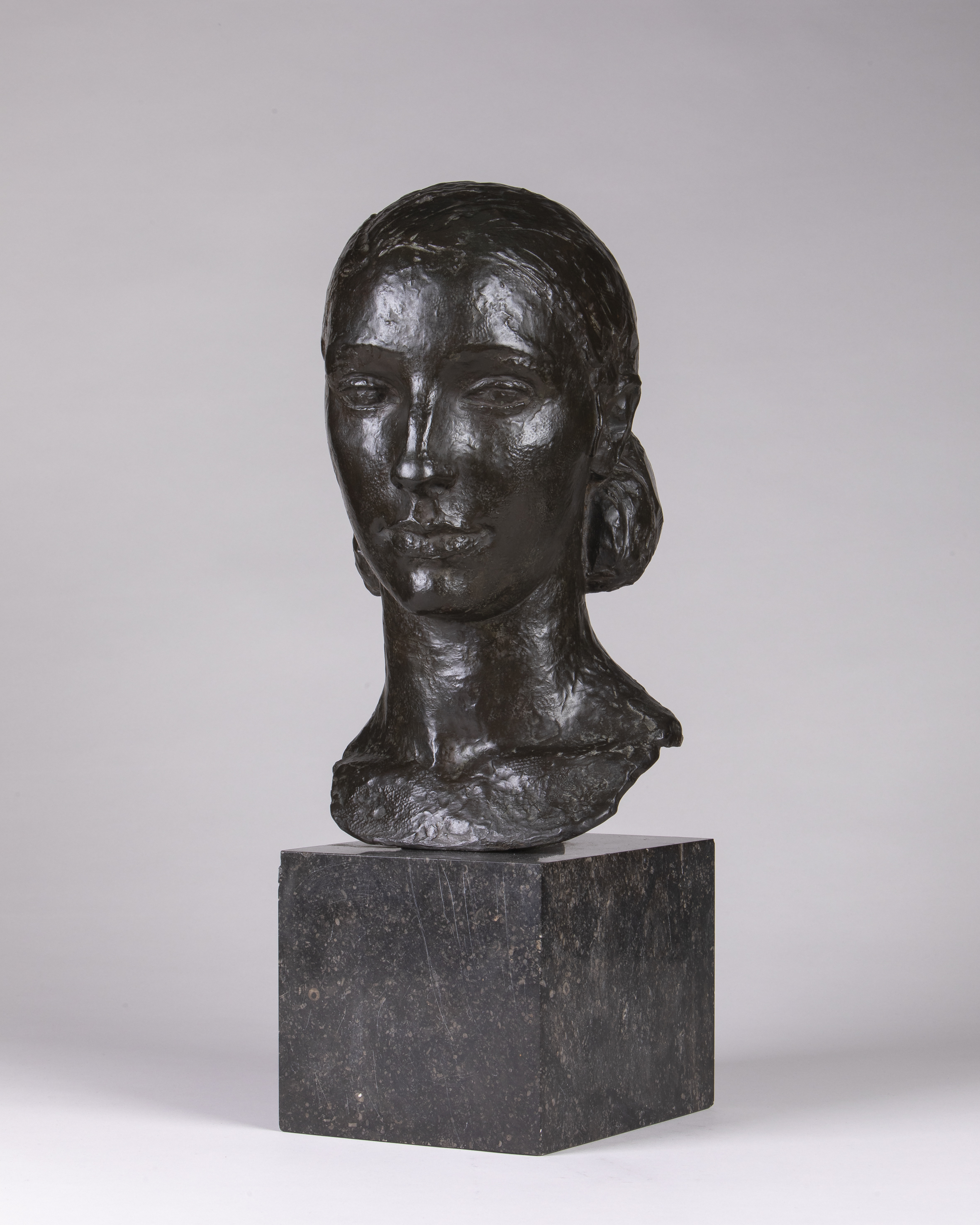
Charles Despiau
Bust of Dominique (Miss D. Jeanès) 1925
Bronze, n°1/8
Lost wax casting by Claude Valsuani
Signed: C. Despiau
H. 34.5, W. 16, D. 23.5 cm
Provenance
- Paris, galerie Barbazanges Hodebert Succr. 109 Faubourg St Honoré;
- Lausanne, Henry-Louis Mermod collection, publisher;
- Lausanne, Catherine Clerc de Goumoëns collection, by descent.
Bibliography
- Internationale Kunstaustellung Dresden (International Art Exhibition Dresden), Dresden, June-September 1926, n°837 (a bronze reproduced fig.18).
- Léon Deshairs, C. Despiau, Paris, Les Ed. Grès & Cie, 1930, n°32 (a bronze reproduced).
- Elisabeth Lebon, Charles Despiau (1874-1946), Catalogue Raisonné of the Sculpture, doctoral dissertation in art history, Université de Paris I – Panthéon Sorbonne, 1995, t. II, vol. 2, p. 270-276.
- Charles Despiau, sculpteur mal-aimé, Musée Beelden aan Zee, La Haye, Pays-Bas, 1st November 2013 – 26 January 2014, Musée Gerhard-Marcks-Haus, Brême, Allemagne, 9 February – 1st June 2014, p.177, (bronze proof #5/8 reproduced fig.22).
Exhibition
- Internationale Kunstaustellung Dresden (International Art Exhibition Dresden), Dresden, June-September 1926, n°837.
- Charles Despiau, sculpteur mal-aimé, Musée Beelden aan Zee, La Haye, Pays-Bas, 1er novembre 2013 – 26 janvier 2014, Musée Gerhard-Marcks-Haus, Brême, Allemagne, 9 février – 1er juin 2014.
The sculpture is accompanied by a certificate attesting to the work’s authenticity and provenance, issued to Mr. Mermod by the Barbazanges Gallery on March 23, 1926.
This piece is listed under number 18-B in the Catalogue raisonné des sculptures de Charles Despiau compiled by E. Lebon.
“I am […] only a sculptor, and I only express myself through artistic means. When I analyze a head, my goal is, above all, to discover its essential rhythm, to put its different parts in order, and to link those parts through accurate transitions. I force myself, not to describe this or that visual detail or state of the soul, but to capture the accord between the sculptural elements that I exalt. In this way, I create a lasting and organized work, and so my busts achieve a deep resemblance; they begin, truly, to live. At times I think I hear them speak.”[1]
Extremely gifted at sculpted portraits, Despiau both worked on commission and rendered the faces of his friends. It is not known which was the case here because the model, Dominique Jeanès, has not been identified. In her thesis, Élisabeth Lebon suggests that she might have been a “relative of the landscape painter Ernest Jeanès, about ten years older than Despiau, who showed at the Salon d’Automne and at the Indépendants.”[2] There was also a pianist and composer named Dominique Jeanès working during the 1930s, and a photograph by Laure Albin-Guillot dating from 1930—an advertisement for Gibbs’ beauty cream and powder—that lists a Dominique Jeanès as the model. It is likely that this bust is of the musician and model.
Whatever the relationship between Despiau and his model, there is no doubt that the young woman’s face, with its balanced and harmonious features, inspired the master. The extreme simplification of the forms and the perfectly proportioned, architectural planes empha its softness and sensuality. This bust is a good example of Despiau’s characteristic ability to observe his model closely and precisely in order to arrive at an idealized vision of universal beauty. This process—the simplification of forms and the economy of artistic means—led him to create several versions of the bust.
The catalogue raisonné of Charles Despiau’s work, established by Élisabeth Lebon in 1995, lists three versions of the portrait of Dominique Jeanès:
—A bust “à l’Italienne”[3] in plaster.[4] In this first version, the face is angled slightly forward and turned to the right’ the bust itself is conservatively dressed.
—A mask in grey terra cotta[5], kept at the National Gallery in Washington, which may well be a cast from the final state of the bust (or a near-final state). It is mounted on a “parallelepiped pedestal made by Despiau himself, and marked by his vigorous work with a gradine[6] (…)”[7]
—A bust cut at the collarbone; the final version is the same as our bust.
In the final state, Despiau straightened the model’s head and created an almost frontal composition, with the face just slightly aside. Through tighter framing, including just the neck and the top of the torso, he focuses attention on the face and the proud bearing of the head, thus distancing himself from the Florentine model and more clearly evoking an antique notion of the bust—perhaps even hinting at the ancient Egyptian, employing a simplified power such as that captured by the sculptor Thoutmôsis in his Bust of Nefertiti.
A large chignon at the base of the neck creates a horizontal line that echoes the line created by the collarbone and contrasts with the almost pointed oval of the lower face. With the features of this lovely face, Despiau has established a melody that is at once harmonious, somber, and vibrant; it recalls his other busts of the same period, such as Mademoiselle Elie Faure, called “Zizou,” and Madame Stone, called “The American.”
For this Bust of Dominique (Miss D. Jeanès), the existence of the following is confirmed:
- Three localised plaster casts, two of which are held in museums [8].
- The bronze edition, limited to 8 bronzes, of which 6 are known:
- One, unnumbered, is in the Staatliche Kunstsammlungen in Dresden in Germany (Inv. ZV 3036)[9] and was acquired at the International Kunstaustellung Dresden in 1926.
- Number 1, which is referenced here above.
- Number 2, is in the Colin Collection in the United States.
- Number 3, which once belonged to Despiau’s great patron, Frank Crowninshield, also used to belong to the Colin Collection, is now kept in the Marjon Collection (Margaret and John Trail) in Australia.
- Number 5, which previously belonged to Georges Renand and is now situated in a private collection in Japan.
- Number 8, which also belonged to Frank Crowninshield, and the Brummer Gallery in New York;[10] its location is unknown.
Our sculpture was sold by the prestigious Barbazanges gallery in 1926.
Henri Barbazanges (1875-1944), founder of the Barbazanges[11] gallery, opened a large exhibition space at 109 rue du Faubourg Saint Honoré in 1910. The gallery quickly became an important advocate for the art of its time. It exhibited works by Delaunay, Marie Laurencin, Matisse, and Modigliani, and showed Picasso's Les Demoiselles d'Avignon to the French public for the first time. In the early 1920s, it acquired Renoir's studio collection, in partnership with the dealer Georges Bernheim, exhibited the Impressionists, and sold important works to several European museums. Taken over by Louis Hodebert (1879-1932) in 1923, it became the Galerie Barbazanges-Hodebert and was the first gallery to exhibit Chagall's works in 1924. In May 1928, the gallery moved to 174 rue du Faubourg Saint-Honoré. The gallery ceased operations for good in 1929.
“Despiau undoubtedly benefited from his deep friendships with popular painters (Derain, Vlaminck, Friesz, Dunoyer de Segonzac, etc.), which introduced him to modern art dealers who were now paying attention to sculptors. He was of particular interest to the Barbazanges gallery, which included him in several group exhibitions between 1920 and 1926.”[12] It was also the Barbazanges gallery that organized the sculptor's first major solo exhibition at the Brummer gallery in New York in 1927, which was a resounding success. That same year, Despiau created a bust of the wife of the new owner of the Barbazanges gallery, Mrs. Hodebert, a patinated plaster cast of which is kept at the Musée national d’art moderne (inv. n° AM 1207 S).
A letter from the “Galerie Barbazanges Hodebert Succr” dated March 23, 1926 informs us that our version was acquired by Swiss patron, collector, and publisher Henry-Louis Mermod (1891-1962). Although he began his career as a lawyer and then an industrialist, “together with Swiss writer Charles-Ferdinand Ramuz (1878-1947), he decided to found his own publishing house in 1926”[13] in Lausanne. The letter acknowledges receipt of payment from Mr. Mermod “in settlement for a bronze by Despiau, ‘Mlle J...’ ” and certifies the authenticity of the acquired work: “I am happy to confirm that this work is indeed by Despiau and that, furthermore, as it is limited to eight copies, it will not be reissued.”
[1] Despiau cited by Jean Alazard, “The Art of Charles Despiau,” Gazette des Beaux-Arts, February 1939.
[2] Lebon, 1995, p.272.
[3] The bust is cut horizontally under the shoulders.
[4] 1925, 45 x 38 x 25 cm, private collection, Paris.
[5] 1925, 23 x 12,6 x 13,9 cm, National Gallery, Washington (Inv. 1969.10.2).
[6] A chisel with a cutting edge composed of flat or pointed teeth. It’s used to remove large amounts of hard stone and to make delicate cuts in softer stone when it’s being cut down (…) A surface worked by a gradine is marked by small cuts, either parallel or going in various directions (…). (Principes d’analyse scientifique : La sculpture, méthode et vocabulaire, imprimerie nationale, 1978, p. 598).
[7] Lebon, 1995, p.274.
[8] In the Kunstmuseum in Berne in Switzerland (Inv.P.1981.7) and in the Museum of Modern Art in New York (Inv.617.39).
[9] Dimensions: 34.4 x 19.7 x 25 cm. Acquired by the city of Dresden during the “Internationalen Kunstaustellung” (the International Art Exhibition) in Dresden in 1926.
[10] Reproduced in the catalogue for the sale Paintings, Sculptures, Drawings and Lithographs by Modern French Artists – Collection of Frank Crowninshield, Parke-Bernet Galleries, Inc., New York, 20-21 October, 1943, n°194.
[11] The gallery's archive collection was acquired from Louis Hodebert's descendant by the Musée d'Orsay in 1994; it can be consulted in the museum's documentation center : https://www.musee-orsay.fr/sites/default/files/2022-06/IR_Barbazanges_Papier_sd.pdf.
[12] Elisabeth Lebon, Charles Despiau. Classique & moderne, Biarritz, Atlantica, 2016, p. 85.
[13] Voir Wikipédia, « Henry-Louis Mermod » : https://fr.wikipedia.org/wiki/Henry-Louis_Mermod