Jane Poupelet
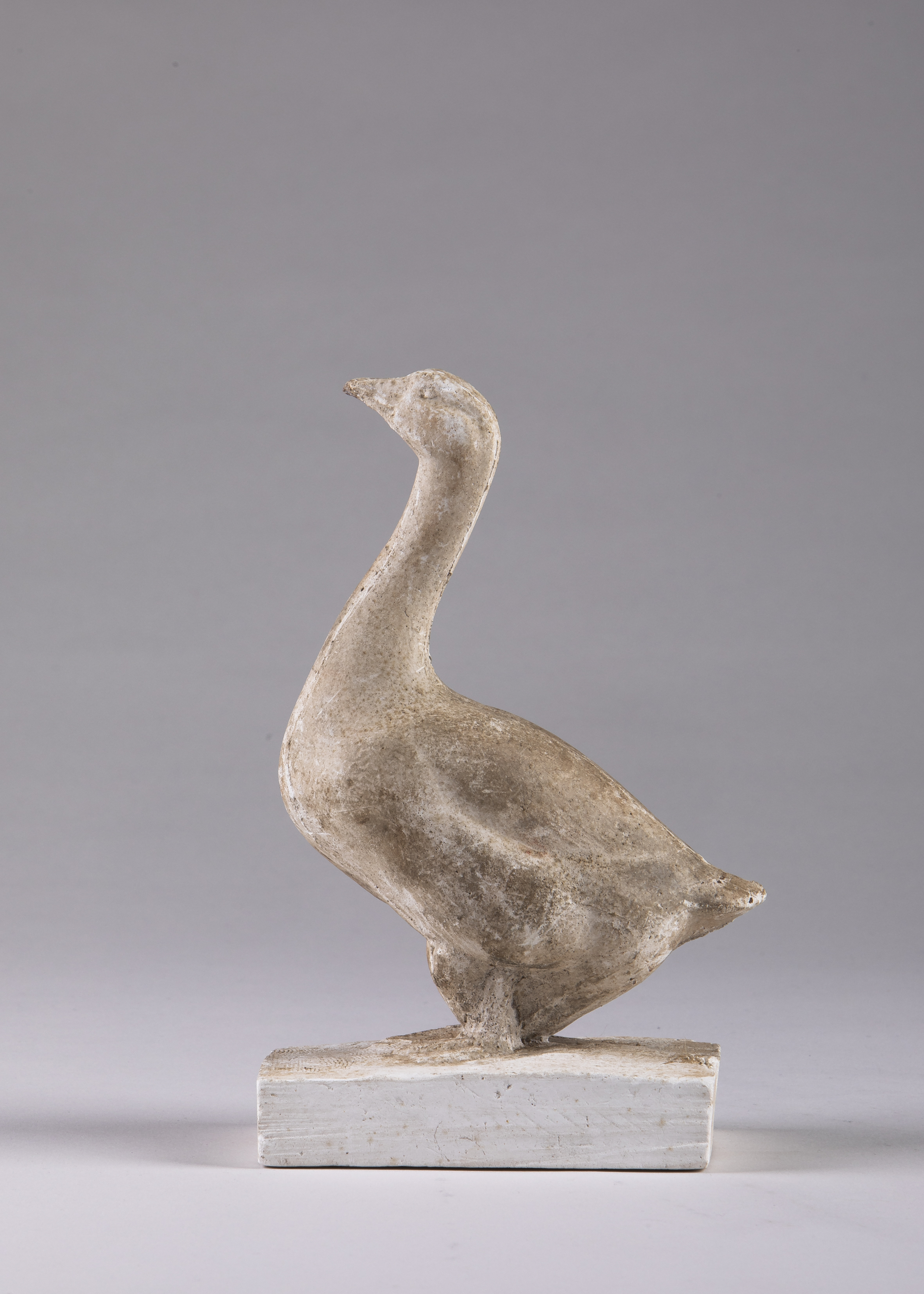
Goose with its Neck Stretched Out, also known as Little Goose 1923
Plaster
Unsigned
16 x 5,9 x 11,2 cm
Provenance
- Artist’s family;
Collection of Julien Saraben (1892-1979), former curator of the Musée du Périgord (until 1957);
Collection of Jacques Saraben.
The sculpture comes with a handwritten letter from the previous owner, Jacques Saraben, dated December 13, 2024, attesting to the provenance of this work.
Selective bibliography:
- 1910 AGEORGES : Joseph Ageorges, « Les petites bêtes de Mlle Poupelet », in Le Mois littéraire et pittoresque, 1910, p. 406-410.
- 1913 GUILLEMOT : Maurice Guillemot, « Jane Poupelet », in Art et Décoration, n°12, décembre 1913, p. 51-56.
- 1924 MARTINIE : Henri Martinie, « Jane Poupelet », in Art et Décoration, septembre 1924, p. 89, repr. (bronze)
- 1930 KUNSTLER : Charles Kunstler, Jane Poupelet, Paris, Éditions G. Crès & Cie, 1930, n°8, NP (p. 24), repr. (bronze)
- 1933 MARTINIE : Henri Martinie, « Jane Poupelet », in L’Art Vivant, n°168, Janvier 1933, NP (p. 3), repr. (bronze)
- 1973 WAPLER : Vincent-Fabian Wapler, Jane Poupelet, sculpteur, 1878-1932, mémoire de maîtrise sous la direction de M. Souchal, Lille, Université Lille III, UFR d’Histoire de l’Art, 1973, n°64, p. 216, repr. (bronze)
- 2005 RIVIÈRE : Anne Rivière, Jane Poupelet 1874-1932. « La beauté dans la simplicité », catalogue d’exposition [Roubaix, La Piscine – musée d’art et industrie André Diligent, 15 octobre 2005 – 15 janvier 2006, Bordeaux, musée des beaux-arts, 24 février – 4 juin 2006, Mont-de-Marsan, musée Despiau-Wlérick, 24 juin – 2 octobre 2006], Paris, Éditions Gallimard, 2005, n°143, p. 109, repr. (other plaster)
- 2011 RIVIÈRE : Anne Rivière, Sculpture’Elles. Les sculpteurs femmes du XVIIIe siècle à nos jours, catalogue d’exposition [Boulogne-Billancourt, musée des Années Trente, 12 mai – 12 octobre 2011], Boulogne-Billancourt, musée des Années Trente-Paris, Somogy, 2011, p. 166-167, repr. (bronze)
- 2017 RIVIÈRE : Anne Rivière, Dictionnaire des sculptrices, Paris, mare & martin, 2017.
“Will I ever cease to marvel at animals?”[1]
Jane Poupelet is passionate about farm animals. Her family owned a large farm in Clauzure, in the Périgord region of Dordogne, where the sculptor was born and surrounded by animals from an early age. She kept a genuine affection for this place, which never really left her. Even after moving to the capital around 1896-1897, Jane Poupelet frequently returned to her native region, dividing her time between Paris and the family estate of La Gauterie, which was populated by domestic and farm animals.
It was this love of animals that earned her critical acclaim. As of 1906, just seven years after her debut at the Salon[2], she presented her first animals: Five Cats at the Salon de la Société nationale des Beaux-Arts in 1906; a Cow Returning to the Barn and a Foal at the Salon d’Automne in 1907, Foal which would be regularly reproduced in the press throughout her career. As early as 1914, a critic complained that her animals were not being exhibited enough: “When will Miss Poupelet give us the pleasure of bringing together her series of small animals in a small exhibition? I remember some of them: ducks, cows, which I would love to see again.”[3]
With this Goose with its Neck Stretched Out, or Little Goose, the artist depicts here the animal with its neck raised and its head slightly partially turned away. The goose is alert, attentive to its surroundings. Extremely lifelike, this Little Goose seems to have been immortalized as it wandered near the artist, before stopping, perhaps alerted by a noise. “Only the mass matters, and with this Goose, we no longer find the details that the artist had adopted to render the plumage of her Rooster[4].”[5]
The goose is one of those animals rarely found in the artist’s bestiary. In the catalogue of her sculpted works, only one other sculpture depicts a goose: Goose with a Curved Neck, a model dating from 1908. Likewise, in her drawings, Poupelet multiplied sketches of the animal on only three sheets worthy of Hokusaï’s La Manga plates: Goose Climbing onto a Feeder, Five Sketches of Geese Eating[6], and Studies of Geese and Ducks, held at the National Museum of Modern Art in Paris (n°inv. AM 1147 D).
The model was exhibited for the first time at the Galerie Bernier during the first major monographic exhibition devoted to Jane Poupelet during her lifetime, in 1928[7]. It was then regularly exhibited, such as at the “Jane Poupelet Retrospective” in 1938[8], shortly after her death, again at the Galerie Bernier; at the musée du Périgord, in 1949[9]; at the musée Rodin, in 1959[10]; or during the exhibition “The Spirit of an Era” organized by the Montmartre to the artists association, in 2001[11].
Critics are unanimous in their praise of these depictions of geese: Charles Saunier (1865-1941) describes the finesse and delicacy of the animal that the sculptor has captured and reproduces: “[…], and such small animals, a goose, for example, testify of Mademoiselle Poupelet’s accurate and intelligently concise observation.”[12] As for Adolphe Basler (1876-1951), he focuses more on the technical prowess achieved by the artist, who manages to convey the sensitivity and personality of the animal: “When Jane Poupelet draws or models a walking cow, a foal, a rabbit, a goose, a rooster, an ox, or a sleeping dog, she shares with us the pleasure she takes in contemplating their perfect structures. Anatomy alone would not suffice to explain their charm. It is the spirit that reveals their character, their harmonious articulation. Their compact silhouette and concise volume are the result of a very simple fantasy, and the simplicity of their execution.”[13]
Jane Poupelet was particularly close to François Pompon (1855-1933) ; it was with him that she founded, in 1931, the “Group of Twelve”, bringing together several animal artists[14]. The latter, along with Marcel Lémar (1892-1941), also offered their interpretations of the animal in sculpture, following in the footsteps of their female colleague : Goose(Paris, musée d’Orsay, n°inv. RF 4257) et Toulouse Goose (Paris, musée national d’art moderne on loan in Roubaix, La Piscine-musée d’art et d’industrie André Diligent, n°inv. AM 749 S). Poupelet’s Little Goose is closer to Lémar’s Toulouse Goose, particularly in the raised neck position and the characteristic shape of the body and plumage, although the smooth modeling and synthesis of forms make it more similar to Pompon’s version. However, Poupelet is the only one who has been able to capture the liveliness and gracefulness of the animal.
To this date, two plasters of the Goose with its Neck Stretched Out, also known as Little Goose have been catalogued:
- a plaster is kept in a private collection[15] ;
- another plaster, presented here. This plaster, kept by the sculptor’s family after her death, joined Julien Saraben’s collection (1892-1979), curator of the musée du Périgord for twenty years, until 1957. After 1979, the sculpture was kept by his son, Jacques Saraben, until recently. In his testimony, the latter explains that his father “got in touch with Jane Poupelet’s cousins, the Cosson sisters. He discovered and purchased works for the musée de Périgueux.”[16] As mentioned above, Jane Poupelet’s family owned a property in the Dordogne region, which explains why our sculpture comes from the Périgord region.
The Little Goose was cast in bronze, with at least five examples catalogued[17] :
- United States, Tiffany collection in 1924;
- United States, Porter collection in 1925. The work, bequeathed by George F. Porter in 1927, is now part of the collections of the Art Institute in Chicago (n°inv. 1927.369);
- United States, Dodge collection in 1927;
- France, André Moulinié collection;
- finally, a cast is kept in the collections of the National Museum of Modern Art in Paris, following the donation by the artist’s sisters to the State in 1934 of more than 64 drawings and 12 sculptures. The work is on loan at the musée des Années 30 in Boulogne-Billancourt since 1995 (n°inv. AM 574 S).
[1] “M’émerveillerai-je jamais assez des bêtes”: Colette, in her Dialogues de Bêtes (Animal Dialogues) published in 1904 (quoted in Pierrette Bourdanton, « Pour un hommage au grand sculpteur Jane Poupelet », in Revue des artistes français, n°9, janvier 1982, p. 8).
[2] Jane Poupelet exhibited for the first time at the Salon de la Nationale des Beaux-Arts in 1899 under the male pseudonym « Simon de La Vergne ».
[3] 1914 DILIGENT, p. 2.
[4] See the factsheet of the Walking Rooster or Chantecler (mettre le lien vers la fiche sur le site de la Galerie ?)
[5] 1973 WAPLER, p. 217.
[6] Voir 2005 RIVIÈRE, n°247, p. 127 et n°248, p. 128, repr.
[7] « Jane Poupelet. Dessins et Sculptures », Paris, Galerie Bernier, 24 janvier – 11 février 1928, n°11 (voir 2005 RIVIÈRE, p. 151).
[8] « Rétrospective Jane Poupelet », Paris, Galerie Bernier, 6-24 mai 1938 (voir 2005 RIVIÈRE, p. 153).
[9] « Exposition Jane Poupelet », Périgueux, musée du Périgord, juin-août 1949, n°17 (voir 2005 RIVIÈRE, p. 154).
[10] « Histoires naturelles », Paris, musée Rodin, 25 juin – 15 octobre 1959, n°125 (voir 2005 RIVIÈRE, p. 154).
[11] « L’Esprit d’une époque », Paris, Montmartre aux artistes, 1er-2 décembre 2001 (voir 2005 RIVIÈRE, p. 155).
[12] Charles Saunier, Le Salon de 1908, Paris, Goupil & Cie, 1908, p. 36.
[13] Adolphe Basler, « Une artiste de race : Jane Poupelet », in La Revue mondiale, 1er mars 1931, p. 80-81.
[14] The group gathers the following painters and sculptors: Charles Artus (1897-1978), Gaston Chopard (1883-1942), Georges Guyot (1885-1972), Georges Hilbert (1900-1982), Adrienne Jouclard (1882-1972), Paul Jouve (1878-1972), Marcel Lémar (1892-1941), André Margat (1903-1997), François Pompon (1855-1933), Jane Poupelet, Anne-Marie Profillet (1898-1939), and Jean-Claude Baugnies de Saint-Marceaux (1902-1979).
[15] 2005 RIVIÈRE, n°143, p. 108-109, repr.
[16] Handwritten letter of Jacques Saraben attesting to the provenance of this sculpture. The musée d’Art et d’Archéologie du Périgord holds 6 sculptures and 14 drawings by Jane Poupelet. The Bather or At the Water’s Edge, a bronze cast, was purchased from the artist’s sisters in 1947, who donated the two following plasters to the museum that same year: Burial of a Child in Périgord and Two Peasants Leaving for the Fields. The other works were donated the following year, in 1948, through the Comité Départemental de Libération de la Dordogne.
[17] 1973 WAPLER, p. 216.