Jane Poupelet
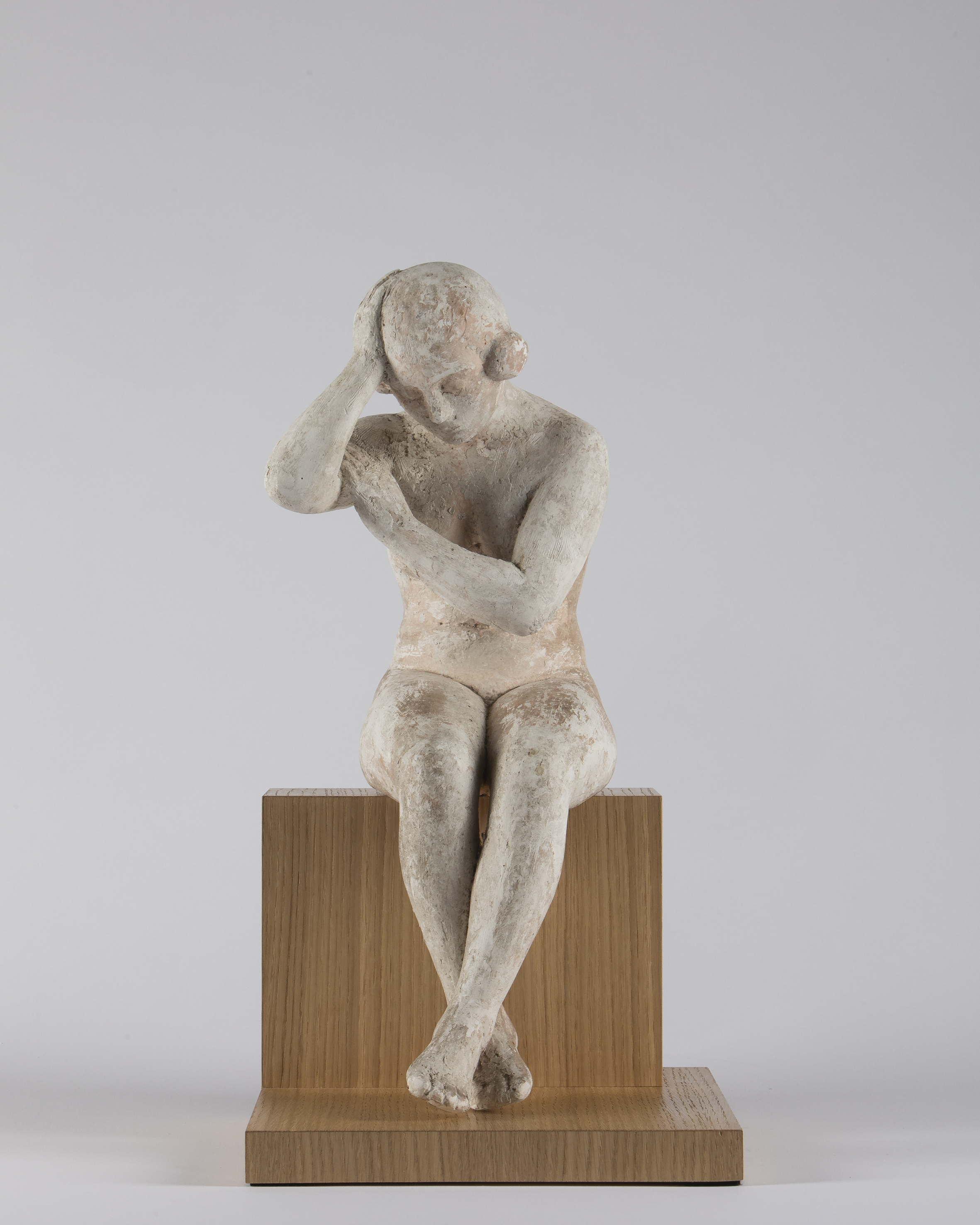
Meditation 1924
Plaster
42 x 17,5 x 27 (dimensions without the base)
Provenance
- The artist’s family
- Collection of Julien Saraben (1892-1979), former curator of the Périgord Museum (until 1957)
- Collection of Jacques Saraben, by descent
The sculpture comes with a handwritten letter from the previous owner, Jacques Saraben, dated December 13, 2024, attesting to the provenance of this work.
Selective bibliography
- 1924 ARTICLE : Martinie, Henri, « Jane Poupelet », Art et Décoration, 1924, n°1456, p.87-96, repr. (plaster).
- 1930 KUNSTLER : Charles Kunstler, Jane Poupelet, Paris, Éditions G. Crès & Cie, 1930, repr., n°9 (bronze)
- 1973 WAPLER : Vincent-Fabian Wapler, Jane Poupelet sculpteur 1878-1932, mémoire de maîtrise présenté sous la direction de Monsieur Souchal Professeur d’histoire de l’art en mai 1973, faculté des lettres et sciences humaines de Lille III, n°62, p.214.
- 2005 RIVIÈRE : Anne Rivière, « Jane Poupelet 1874-1932 « La beauté dans la simplicité » », in Jane Poupelet (1874-1932), catalogue d’exposition, Roubaix, La Piscine – musée d’art et industrie André Diligent (15 octobre 2005– 15 janvier 2006) ; Bordeaux, musée des Beaux-Arts (24 février – 4 juin 2006) ; Mont-de-Marsan, musée Despiau-Wlérick (24 juin – 2 octobre 2006), Paris, Éditions Gallimard, 2005, n°87, p.100, repr. (bronze).
Exhibitions of Meditation immediately after its creation
- 1924 Paris, Salon des Tuileries, n°1253
- 1930 Paris, Salon des Tuileries, n°2314
- 1930 Paris, Galerie Bernier (5 ex.)
- 1938 Paris, Galerie Bernier, rétrospective Poupelet
“The planes and volumes of her nudes obey her calculations and reject all impressionism; thus she achieves beautiful, disciplined rhythms.”[1]
Meditation dates from 1924 but partly reprises the composition of a model of a Seated Woman created by the artist in 1913 and retouched to produce a truncated version, without arms or head, in 1922. In these three sculptures, a female nude is seated, her back straight and her neck bent forward; but the position of the legs, which are parallel in the Seated Women, are crossed in Meditation, and the movement of the arms is also unusual here, as both are bent, one resting on the other, which in turn rests on the head. This is an uncommon posture, creating a rhythm of broken lines that respond to the gentle curves of the bust.
This simple composition of a woman seated on a parallelepiped pedestal is reminiscent of certain sculptures from the Late Period of Egyptian art. But it does not have its solemnity. Her members are in dynamic tensions; the uncomfortable position suggests movement. Jane Poupelet draws inspiration from the art of the Mediterranean region. These references result particularly from her training with Lucien Schnegg, founder of the Bande à Schnegg, of which the sculptor was a member at the turn of the century. This group brought together independent sculptors who broke with Rodin’s lyrical style, advocating a return to ancient calm.
Here, idealization and the beauty of proportions do not exclude a certain realism imbued with sensuality: we notice the soft rolls on the belly, the pressure of the arm folded over the breast, the subtle texture of the pubic area.
Entitled Meditation, the composition suggests introspection and melancholy, themes found in the artist’s post-war work. She was very involved during the war, repairing the gueules cassées[2] thanks to her mastery of the art of modeling; then, from 1922 on, she suffered from the early stages of an illness that would take her life ten years later. The subjects of her sculptures echo the turmoil she feels. However, Jane Poupelet, who had always been a committed artist, particularly in feminist movements, remained active and, together with Suzanne Noël, founded the Soroptimist Club in 1924[3], an interprofessional association of women that quickly became an international network. She also was a renowned and highly regarded artist who exhibited extensively in Europe and the United States.
Meditation was exhibited for the first time at the Salon des Tuileries in 1924. The plaster work was then reproduced in an article by Martinie in the magazine Art et Décoration[4]. The sculpture was exhibited again in the 1930 edition of the Salon des Tuileries, then featured in the artist’s second solo exhibition at the Galerie Bernier. It was stated that only five casts would be produced.
However, only one bronze is currently known to exist, located in a private collection: it is a gilded bronze, numbered I/IV.
A second plaster is held in the artist’s family.
Our plaster, preserved by the sculptor’s family after her death, became part of the collection of Julien Saraben (1892-1979), curator of the Périgord Museum for twenty years until 1957. After 1979, the sculpture was kept by his son, Jacques Saraben, until recently. In his testimony, the latter explains that his father “came into contact with Jane Poupelet’s cousins the Cosson sisters. He discovered and purchases works for the Périgueux Museum.”[5] Jane Poupelet’s family owned a large farm in Clauzure, in the Périgord region of the Dordogne, where the sculptor was born. Jane Poupelet frequently returned to her native region, diving her time between Paris and the family estate of La Gauterie. This explains the Périgord origin of our sculpture.
Meditation in plaster is a rare and moving example of Jane Poupelet’s post-war sculpture and perfectly demonstrates the sculptor’s talent for highlighting the female form with harmonious proportions, sensual and sensitive modeling, and clean, regular lines, all in the service of a perfectly rhythmic composition.
[1] 1928 MARTINIE, p.83.
[2] Literally “Broken Faces”; name given by the French to the facially disfigured soldiers at the end of the First World War.
[3] To learn more about the Soroptimist Club: https://bhvp.hypotheses.org/12570
[4] 1924 ARTICLE, repr. p.95.
[5] Handwritten letter from Jacques Saraben attesting to the provenance of this sculpture.
Handwritten letter of Jacques Saraben attesting to the provenance of this sculpture. The musée d’Art et d’Archéologie du Périgord holds 6 sculptures and 14 drawings by Jane Poupelet. The Bather or At the Water’s Edge, a bronze cast, was purchased from the artist’s sisters in 1947, who donated the two following plasters to the museum that same year: Burial of a Child in Périgord and Two Peasants Leaving for the Fields. The other works were donated the following year, in 1948, through the Comité Départemental de Libération de la Dordogne.