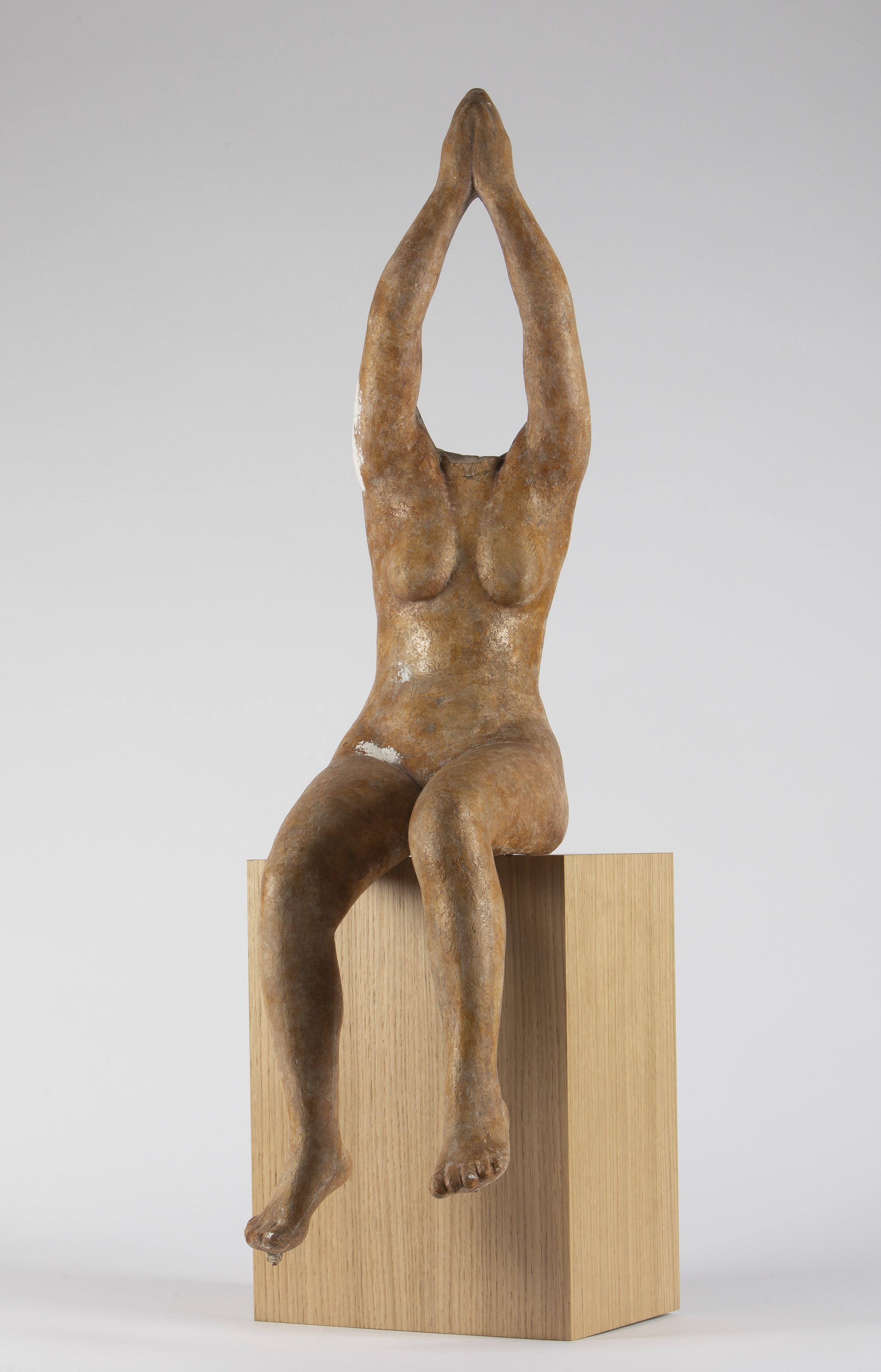
Jane Poupelet
Imploration 1923-1925
Patinated plaster
79,5 x 21,5 x 32 cm (dimensions without the base)
Provenance
- The artist’s studio
- France, private collection
Bibliography
- 1930 KUNSTLER : Charles Kunstler, Jane Poupelet, Paris, Éditions G. Crès & Cie, 1930, repr., n°13 (bronze)
- 1930 EXPOSITION : Jane Poupelet Sculptures et Dessins, Paris, Galerie Bernier, 10 rue Jacques-Callot, 19 juin -9 juillet, 1930, repr. on the cover (bronze).
- 1938 EXPOSITION : Jane Poupelet Sculpteur, Paris, Galerie Bernier, 10 rue Jacques-Callot 6 – 24 mai, 1938, non repr.
- 1973 WAPLER : Vincent-Fabian Wapler, Jane Poupelet sculpteur 1878-1932, mémoire de maîtrise présenté sous la direction de Monsieur Souchal Professeur d’histoire de l’art en mai 1973, faculté des lettres et sciences humaines de Lille III, n°69, p.223.
- 2005 RIVIÈRE : Anne Rivière, « Jane Poupelet 1874-1932 « La beauté dans la simplicité » », in Jane Poupelet (1874-1932), catalogue d’exposition, Roubaix, La Piscine – musée d’art et industrie André Diligent (15 octobre 2005– 15 janvier 2006) ; Bordeaux, musée des Beaux-Arts (24 février – 4 juin 2006) ; Mont-de-Marsan, musée Despiau-Wlérick (24 juin – 2 octobre 2006), Paris, Éditions Gallimard, 2005, n°83, p.99, repr. (gilded bronze).
Exhibitions of Imploration immediately after its creation:
- 1925 Paris, Salon des Tuileries, n°1232 (plaster)
- 1928 Paris, Galerie Bernier, n3 (Seated Woman plaster 1923)
- 1928 New York, Montross Gallery, n°53 (Bather)
- 1930 Paris, Galerie Bernier, n°1 (bronze)
- 1931 Prague, musée national, « École de Paris »
- 1938 Paris, Galerie Bernier, rétrospective Poupelet
“What a sensual arabesque describes this body, whose arms raised in prayer elongate its undulating forms! And what a thrill is molded throughout this body, whose flesh is made of such dense and tight fabric! Seeing the movement of this beautiful statue, which seems to be striving to lift itself off the ground, seeing it deprived of its head and yet so alive and poignant, one would take it for some mutilated Prayer… » Kunstler, 1930[1]
This iconic work by Jane Poupelet is her last sculpture. The artist, though young, is ill and will remain so until her death: as early as 1923, her friends noticed a tone of weariness in her[2] and from 1926 onwards, she only produced drawings. But this figure of Imploration is both the stopping and culminating point of a long series of female nudes begun by the artist in 1907 with Woman at her Toilette and continued with Woman Looking at her Reflection in the Water (1909), Facing the Wave (1909) or The Bather (1911-1918), so many representations of a modern woman who is accomplished, independent and athletic. This positive and dynamic vision did not continue after the war, when a certain melancholy became apparent, with a more inward gaze and introspective themes in Kneeling Woman with Arms Outstretched, Meditation. Imploration is part of this vein and seems to convey a state of suffering, a loss of hope: in the face of the political context? Or more personally, in the face of illness?
The posture of this headless body, with hands clasped in prayer, arms stretched towards the sky and legs dangling, is striking. Seated, but with limbs floating in the air, the body unfolds in a fragile undulation contrasting with the stabilizing parallelepiped base. Everything in this composition expresses the vulnerability of the body, and what can be said about the absence of a head? It is not uncommon in Poupelet’s work, particularly in her drawings. Many drawings show a model without a head or with a head outside the frame. And several of her sculptures are headless, such as Headless Nude Resting on a Pedestal (c. 1908) or Seated Woman (1913-1922). Before the war, it is noteworthy that her sculptures of female nudes often feature her self-portrait as the face. On the contrary, the absence of faces in both her sculptures and drawings seems to indicate that she considers them anecdotal in terms of what she is trying to convey: the body has its own sufficient expression. Here, its absence makes the expression of suffering more eloquent. The entire body, in the sine way it describes, is a supplication.
But it is also a shape that embraces the air, reaching towards the sky. In 1923, that same year, Brancusi created Maïastra, the first version of his Birds in Space, comparable in their upward momentum to the brink of imbalance. The two artists moved in the same circles and exhibited together at the Tri-National Exhibition in June 1925 at the Durand-Ruel Gallery.
Jane Poupelet often practices marcottage, following in the footsteps of Rodin and Bourdelle. From the shapes she creates, she cuts, collects, assembles, and thus creates new shapes. This is also the case for Imploration, the first version of which was complete as evidenced by a photograph published in the New York Times in 1916[3], as well as several preparatory drawings[4]. As with Seated Woman (1913-1922)[5], the complete model dates from before the war and was revisited in the 1920s to create a truncated version that was cast in bronze. We know of at least two drawings featuring the headless figure, one of which is said to be a Study for the figure of Imploration[6]; the other is kept at the Centre Pompidou and appears early on, as it is dated 1906 (Seated Nude with Arms Raised, inv AM 1202D).
This drawing is reproduced in the catalogue of the monographic exhibition that the Bernier Gallery in Paris dedicated to Jane Poupelet in 1930; and Imploration is featured on the cover of this same catalogue[7]. The sculpture is often chosen by the artist to represent her. Later, in 1974, she took part in the major exhibition La Bande à Schnegg[8], spearheaded by Jane Poupelet, which brought together sculptures by various members of this movement who advocated a return to the smooth, synthetic forms of Greek classicism, breaking with the lyrical, impressionistic art of Rodin.
Jane Poupelet first exhibited Imploration in plaster in 1925 at the Salon des Tuileries; then again in at the Galerie Bernier in 1928, still in plaster[9]. The work was also exhibited in New York at the Montross Gallery the same year[10]. In 1930, for the artist’s second exhibition at the Galerie Bernier, it was the bronze that was exhibited, entitled Imploration, and it was stated that the bronze edition would be limited to 5 casts.
However, only two bronzes are currently known and located:
- Paris, National Museum of Modern Art (inv AM565S – gift from the artist’s family in 1934) : this slightly gilded bronze is on loan to La Piscine – Museum of Art and Industry André Diligent.
- Paris, private collection: gilded bronze.
We know of the existence of two other plasters, kept in a private collection.
The patinated plaster presented here was used for the bronze casts. As Martinie attests in a 1924 article[11], we know that her “desire for perfection led her to retouch, chisel, and patinate the bronzes returning from the foundry herself, with the utmost care”; similarly, her Imploration in plaster bears traces of her later retouching.
Imploration is a sculpture with a free and radical composition; a work whose modernity astounds the viewer. The plaster presented here is a rare and moving example.
[1] 1930 KUNSTLER, p.12-13.
[2] 1973 WAPLER, p.48.
[3] 2005 RIVIÈRE, p.45.
[4] 2005 RIVIÈRE, p.130 n°273: Preparatory Study for Imploration, mine de plomb; 26,7 x 20,5 cm, coll.part.
[5] 2005 RIVIÈRE, n°76, p.98.
[6] 2005 RIVIÈRE, n°275, p.131: plume et lavis de brou de noix sur papier, 40 x 26,5 cm, coll. part.
[7] 1930 EXPOSITION.
[8] La bande à Schnegg, catalogue d’exposition du musée Bourdelle, juin-septembre 1974, éd. Musée Bourdelle, Paris, cat.114, repr.pl XIV.
[9] 2005 RIVIÈRE p.151: according to this catalogue, sculpture no. 3 entitled Seated Woman in this exhibition would be Imploration.
[10] 2005 RIVIÈRE p.152: according to this catalogue, sculpture no. 53 entitled Bather in this exhibition would be Imploration.
[11] Martinie, Henri, « Jane Poupelet », Art et Décoration, 1924, p.96.