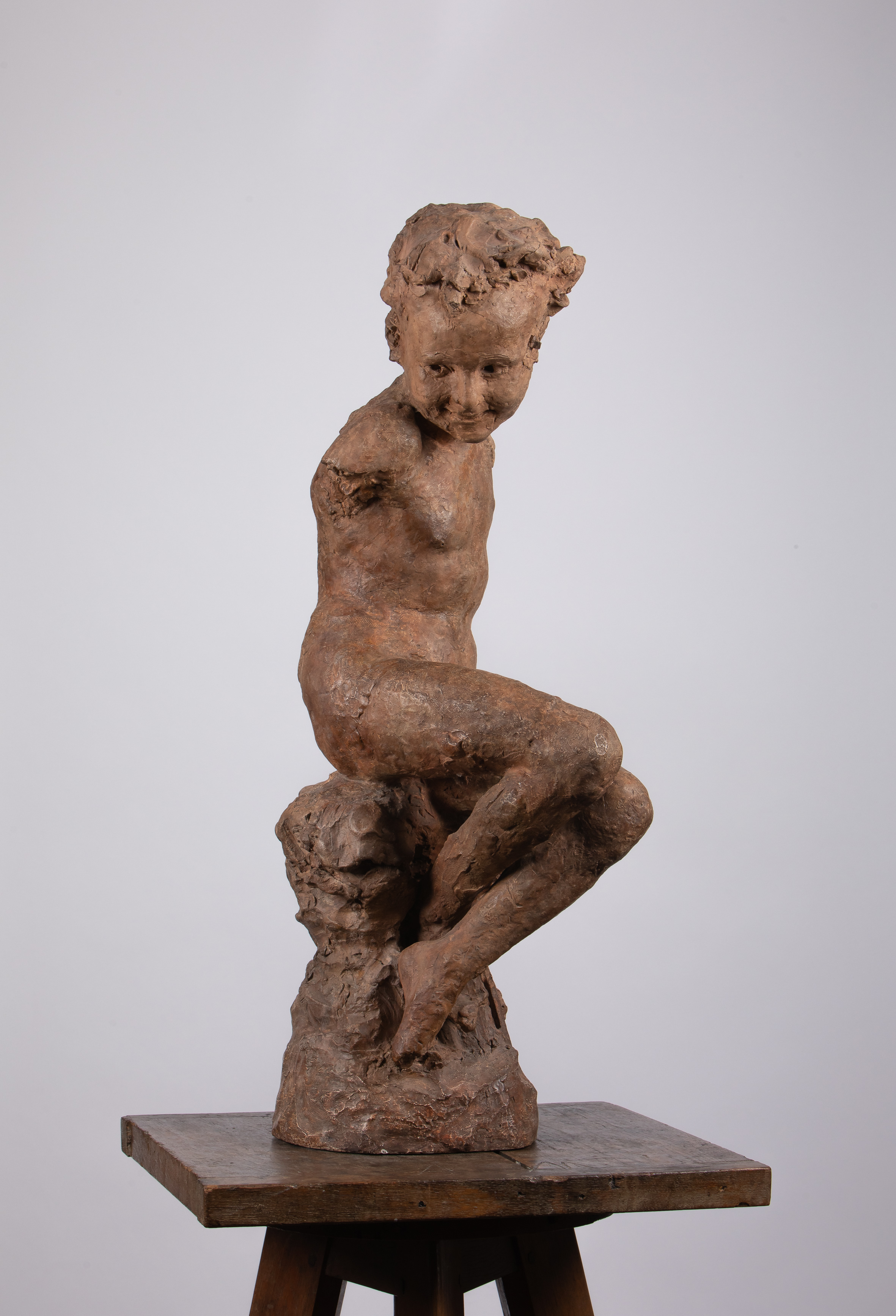
Jean-Baptiste Carpeaux
Mocking Love 1873
Terracotta and plaster, with exposed armature
Signed et dated (on the base, lower right): JB Carpeaux 1873
78 x 21,5 x 35 cm
Provenance
- Jean-Baptiste Carpeaux (1827-1875) ;
- Louise Clément-Carpeaux (1872-1961), his daughter ;
- Sale, Paris, Galerie Georges Petit, Me Henri Baudoin, December 11, 1925, lot 29 ;
- Maurice-Alphonse Renouard-Larivière (1854-1930) ;
- Jean Renouard-Larivière (1891-1977), his son, husband of Dolores de Yturbe (1903-1992), by descent ;
- Sale, Paris, Hôtel Drouot, Thierry de Maigret, March 27, 2019, lot 222 ;
- Paris, Galerie Talabardon & Gautier ;
- European collection.
Bibliography
- 1880 CHESNEAU : Ernest Chesneau, Le statuaire J.-B. Carpeaux. Sa vie et son œuvre, Paris, A. Quantin, Imprimeur-éditeur, 1880.
- 1913 MARGUERITTE : Victor Margueritte, « Préface », in Atelier J.-B. Carpeaux (Deuxième et dernière Vente), catalogue de vente [commissaire-priseur Henri Baudoin, experts Durand-Ruel & fils, J. & G. Bernheim-Jeune, Paris, Galerie Manzi-Joyant, 8-9 décembre 1913], Paris, Imprimerie de l’Art, 1913.
- 1925 CATALOGUE VENTE PARIS : Tableaux modernes et anciens, Aquarelles, Objets d’Art et d’Ameublement, Tapisseries flamandes, catalogue de vente [commissaire-priseur Henri Baudoin, experts André Schœller, Jules Féral, MM. Mannheim, Paris, Galerie Georges Petit, vendredi 11 décembre 1925], Paris, Imp. Georges Petit, 1925, n°29, p. 12-13, repr. (our sculpture).
- 1934 CLÉMENT-CARPEAUX : Louise Clément-Carpeaux, La Vérité sur l’œuvre et la vie de J.-B. Carpeaux, t. I, Paris, Dousset et Bigerelle Imprimeurs, 1934.
- 1935 CLÉMENT-CARPEAUX : Louise Clément-Carpeaux, La Vérité sur l’œuvre et la vie de J.-B. Carpeaux, t. II, Nemours, Imprimerie André Lesot, 1935.
- 1978 CATALOGUE MUSÉE PARIS : Anny Braunwald, André Hardy, Catalogue des peintures et sculptures de Jean-Baptiste Carpeaux à Valenciennes, Valenciennes, Musée des Beaux-Arts, 1978, n°233, p. 102, pl. 55, repr. (terracotta, Valenciennes, Musée des Beaux-Arts).
- 1984 KOCKS : Dirk KOCKS, Jean-Baptiste Carpeaux : Rezeption und Originalität, Sankt Augustin, Richarz, 1981, p. 292, pl. 79, repr. (terre cuite, Valenciennes, Musée des Beaux-Arts).
- 2003 POLETTI-RICHARME : Michel Poletti, Alain Richarme, Jean-Baptiste Carpeaux, sculpteur. Catalogue raisonné de l’œuvre édité, Angers, Expressions contemporaines-Paris, Éditions de l’Amateur, 2003, n°ES 3, p. 154, repr. (terracotta, Valenciennes, Musée des Beaux-Arts).
- 2014 CATALOGUE EXPOSITION PARIS : James David Draper, Édouard Papet (sous la direction de), Carpeaux (1827-1875). Un sculpteur pour l’empire, catalogue d’exposition [New York, The Metropolitan Museum of Art, 10 mars – 26 mai 2014, Paris, Musée d’Orsay, 24 juin – 28 septembre 2014], Paris, Gallimard-Musée d’Orsay, 2014, p. 231.
"Her beauteous arms about my neck she throws,
And fondly clasping me, my mouth she kist,
If to my inmost heart the arrow goes
Which Love directs, may well by you be wist"[1]
Genesis of two Amours
L’Amour moqueur (Mocking Love) is one of the last sculptures created by Jean-Baptiste Carpeaux. From 1873 onwards, the sculptor's health began to decline. He was diagnosed with incurable bladder cancer, which caused him terrible suffering until his death on October 12, 1875. The sculpture was conceived as a counterpart to L'Amour blessé(Wounded Love), a work created between 1873 and 1874. The story behind the latter is told by the artist's daughter, Louise Clément-Carpeaux (1872-1961), in her biography of her father: "Charles, his firstborn, was getting off a train with his mother when his arm was dislocated by the carriage door. The poor little boy was in great pain. It was necessary to repeatedly massage his little arm, which was very painful. To console the child during these operations, my mother gave him a tamed dove; Carpeaux, who was watching the scene, noticed the dear little boy's grace and grabbed a handful of clay. Soon, he decided that his son would pose for him every day: the small model he had made with a few strokes of his thumb had given him a taste for it. My mother was somewhat indignant to see her suffering child subjected to this slight constraint; as for Charles, he cried and invented a thousand little tricks to escape his father... Carpeaux was inflexible, and L'Amour blessé immortalizes the child." [2]
This “small clay model” of L'Amour blessé is now kept at the Petit Palais (inv. no. PPS1577), while the sinuous position of the child's body was inspired by another terracotta model, Charles Carpeaux on his mother's lap, kept at the Musée des Arts Décoratifs (inv. no. 5243). The sculpture was finally produced in marble and exhibited at the Salon in May 1874: the bandage on the elbow recalls little Charles' injury in the family anecdote, as does the dove lying at the child's feet. At the Salon, the sculpture was spotted by the Romanian-born Prince Georges B. Stirbey (1828-1925), Carpeaux's last patron, who acquired it on June 27, 1874, for his château in Bécon, Courbevoie. The sculpture was delivered to him the very next day [3].
L’Amour moqueur seems to have been created at the same time as L’Amour blessé, as the sculpture is dated “1873” in the plaster. However, it appears that the work dates from 1875[4], due to Carpeaux's relationship with Prince Stirbey. A letter sent by the sculptor to his patron, dated February 7, 1875, raises doubts: "[...] I thank you in advance, Prince, for your kind interest in my poor health. You have one of my works, l'Amour Blessé. I will have to make a companion piece dedicated to gratitude if I can ever pick up my chisels again."[5] The letter was posted from 69, Boulevard Saint-Jacques, the address of the studio of painter Bruno Chérier (1817-1880), an artist from Valenciennes and lifelong friend of Carpeaux, with whom he was staying. As indeed, "On April 17, 1874, Jean-Baptiste Carpeaux left his beautiful house in Auteuil and his studios, never to return. From then on, he wandered from one makeshift lodging to another, at the mercy of the conflicts of interest surrounding his work and, above all, the rights attached to it. "[6] He was first hospitalized for a few months at the Maison Dubois. He then settled for a while with Bruno Chérier, before being taken in by Prince Stirbey at his estate in Nice, then in Courbevoie, where the sculptor passed away. When he left his family home and studios in early 1874, Carpeaux was already in poor health. The artist would only sculpt very rarely, when his illness gave him a little respite, and would thus focus on drawing and painting. L'Amour moqueur was therefore abandoned unfinished in his studio before his hasty departure. The child was supposed to be hiding a bow behind his back, a project that the sculptor unfortunately did not have time to complete. In addition, the arms that once adorned the sculpture eventually fell off, as the clay was no longer being moistened regularly.
Carpeaux and Italy, another "histoire d’Amour"[7]
This Amour moqueur may have been conceived as the cause of the pain of Amour blessé, of which he is the counterpart: could he not be the author of his wound to the arm and of the death of his dove, pierced by arrows? Let us remember that "According to Diotima, Eros is a ‘demon,’ an intermediary between gods and men. [...] he is a perpetually dissatisfied and restless force. [...] Gradually, under the influence of poets, the god Eros took on his traditional appearance. He is depicted as a child, often winged, but also wingless, who delights in causing turmoil in people's hearts. He either sets them ablaze with his torch or wounds them with his arrows. [...] But always—and this is a favorite theme of poets—behind the seemingly innocent child, we sense the powerful god who can, at his whim, inflict cruel wounds.”[8]
Carpeaux is undoubtedly referring here to L’Amour menaçant (Love Threatening) by Étienne Falconet (1716–1791), now in the Louvre (inv. no. RF 296). But more than Falconet, the artist was explicitly inspired here by the Italian Renaissance. At the end of 1854, Carpeaux won the Grand Prix de Rome in Sculpture for his Hector imploring the gods on behalf of his son Astyanax. He had been waiting for this for more than seven years, so much so that the year before his consecration, he confided in his friend Chérier: “Patience, and we will go together to draw all the secrets of art from this beautiful Italy; we will seek inspiration from the immortal school of our great masters. There we will be compensated for the hardships that fate has imposed on us. That is where hearts like ours should have been born.”[9] However, due to various commissions he had to fulfill, the sculptor was unable to travel there until January 1856. From then on, he immersed himself in classical Italian visual culture, particularly the art of the man he considered to be one of the greatest: Michelangelo (1475-1564). Carpeaux was a true devotee of the master[10] : in another letter dated from his arrival in the Italian capital, he wrote: “I keep seeing the masterpieces of the men who have brought fame to their country. It is impossible to form an idea of Michelangelo [sic]; he overwhelms everything, he is formidable in appearance, striking in character, and incomparable in his knowledge.”[11]
In Rome, he drew from the ceiling of the Sistine Chapel. In Paris, at the Louvre, he sketched the Slaves over and over again. The sinuous, serpentine bodies of the Italian master particularly inspired Carpeaux's art, which can be seen in L'Amour moqueur, but also in one of his greatest successes during that same stay in Rome: Le Pêcheur à la coquille (Neapolitan Fisherboy) (Washington, National Gallery of Art, inv. no. 1943.4.89). There is a great similarity in the off-center bodies of the two young boys: their torsos and crossed legs are turned in opposite directions, while their faces, and especially their gazes, are also turned in directions opposite to the position of their bodies. These opposing lines create movement and great dynamism in the composition, encouraging the viewer to walk around the work. The model of Le Pêcheur à la coquille was so successful that Carpeaux created a companion piece to his sculpture: La Jeune fille à la coquille ( Girl with a Shell) (Washington, National Gallery of Art, inv. no. 1943.4.90). Carpeaux undoubtedly hoped that, with Amour moqueur and Amour blessé, he would repeat the success of his early career with a new pair of sculptures.
Likewise, Le Pêcheur à la coquille and l’Amour moqueur share a second common inspiration: the world of childhood. “Children always stirred feelings of infinite tenderness in Carpeaux,”[12], said Ernest Chesneau (1833-1890), one of Carpeaux's first biographers. It is no coincidence that the first subject he sculpted upon his arrival in Rome was a Petit boudeur (Paris, Musée d'Orsay, inv. no. RF 1895), or that the artist's other great commercial success was the portrait of the Prince imperial et son chien Néro (Imperial Prince and his dog Néro) (Paris, Musée d'Orsay, inv. no. RF 2042). This is why, when his first son, Charles Carpeaux (1870-1904), was born, he became the source of inspiration for numerous works: drawings[13], paintings[14],and sculptures, such as his Buste d’enfant aux roses (Paris, Petit Palais, nºinv. PPS1544), or L’Amour blessé and L’Amour moqueur, already mentionned.
A unique Amour
Our terracotta sculpture of L’Amour moqueur is an extremely rare and unique work. The last original terracotta of this and importance created by Carpeaux, it conveys great emotion. This is evident not only in its theme, the portrait of a son by his father, or in the prestigious Roman past from which it draws its inspiration, two elements that were dear to its creator, but also in its technicality and sensitivity. The work was modeled by the sculptor himself. As a result, the clay retains the sculptor's fingerprints, various tool marks, and even traces of the fibers from the cloths used to prevent the clay from drying out. On this subject, the author Victor Margueritte (1866-1942) wrote, echoing the words of the art critic Maurice Guillemot (1859-1931): "These models, in which the first vision pulsates naked in the dried clay! This still quivering silt that retains, along with the imprint of the fingers, the creative soul! Feverishly kneaded balls of clay, ‘sketches of statues never made, glimpsed ideas,’ – all the exciting secrets of gestation, a whole world of tiny masterpieces: forms in the making, movement captured, thought in its prime..."[15]. The iron bar that forms the gallows also remains visible at the base and on the child's face. This original terracotta piece is a valuable testimony to workshop practices and the process of creating a sculpture.
Finally, our work is also prestigious because of its provenance. Upon the sculptor's death, his daughter, Louise Clément-Carpeaux, inherited the work that remained in her father's studio. We know that she was particularly fond of the work, which she kept carefully in her collection until the mid-1920s, as shown in this photograph dated 1925, in which she poses surrounded by her father's works, most notably L'Amour moqueur and Le Pêcheur à la coquille (fig. 1). From 1923 onwards, Louise Clément-Carpeaux authorized Maison Susse Frères to produce the model in terracotta, plaster, and bronze. The casts were made between 1923 and 1969[16]. The first terracotta cast, made in 1923, was donated by Louise Clément-Carpeaux to the Musée des Beaux-Arts in Valenciennes (inv. no. S.92.78). A version in plaster is also kept at the Petit Palais (inv. no. PPS1561), donated by the artist's daughter in June 1938.
Louise finally parted with the work in 1925, and it was put up for auction on December 11 under the hammer of Henri Baudoin (fig. 2). The sale was announced in the press, including in the daily newspaper Le Gaulois on December 8, 1925, in which Maurice Feuillet praised “L’Amour moqueur [...] whose grace is reminiscent of the most exquisite works of ancient Greece and the Italian Renaissance.” [17] On December 12, Maurice Monda announced in Le Figaro that the work had been sold for 31,000 francs[18]. However, the minutes of the sale indicate that the sculpture was withdrawn from the sale[19]. In any case, L’Amour moqueur has now changed hands, and the buyer is none other than Maurice-Alphonse Renouard-Larivière (1854-1930), a major collector of Carpeaux's work[20] who made his fortune in Argentina, where he developed the railways. The correspondence between the sculptor's heiress and the new owner of the work shows how much Louise cared about L'Amour moqueur, as evidenced in particular by this letter dated October 20, 1926: "Sir, I am enchanted by the visit I had the pleasure of paying you last Thursday. You are a happy mortal to live surrounded by so many wonders! I was particularly happy to admire two of my father's works in your home, which are among his most perfect. [...] As for L'Amour moqueur, it is true love! A jewel. Here again, you have a rare piece. This terracotta is the very clay kneaded by Carpeaux. The armature fired with the clay attests, if there were any doubt, to the originality of this charming figure, in which my father sought a counterpart to wounded love."[21].
Maurice-Alphonse Renouard-Larivière married María Luisa Dose Armstrong (1868–?) on May 17, 1890, in Buenos Aires. They had two sons, including Jean Renouard-Larivière (1891–1977), who was born in Buenos Aires. The latter, a civilian attaché at the Argentine Embassy, also married a woman of Argentine origin: Dolores, known as “Lolita,” de Yturbe (1903-1992). The socialite couple was an integral part of Parisian high society, as evidenced by the announcement of their marriage in various fashion magazines in October 1928[22]. Owners of a mansion located at 8 bis, rue de Presbourg in the 16th arrondissement of Paris, redesigned by architect and decorator Emilio Terry (1890-1969) in the 1960s (fig. 3), the couple inherited L'Amour moqueur upon Maurice-Alphonse's death in 1930. The work remained in the family until it reappeared on the market in 2019.
L’Amour moqueur is a true masterpiece of modern sculpture. An extremely rare and unique piece, the artist allows us to enter into the intimacy of his creation. The modeling, worked quickly, makes us feel Carpeaux's urgency to capture his idea before it escaped him and time ran out. This urgency can be found, a few years later, in the work of sculptors of subsequent generations, such as Alberto Giacometti (1901-1966) and Germaine Richier (1902-1959), for example.
[1] Ludovic Arioste (1474-1533), The Orlando furioso, translated in English by W.S. Rose, volume II, London, George Bell & Sons, p. 12.
[2] 2014 CATALOGUE EXPOSITION, p. 230. The anecdote recounted by Louise comes from her mother, Amélie Carpeaux, née de Montfort (1847–1908). The story is also corroborated by a friend of Carpeaux, Louis Barnet, also a sculptor, in a document annotated in his own hand. The archive is now kept at the Institut National d'Histoire de l'Art (INHA), cote Ms101.
[3] “Would you kindly inform me that the lovely collection L'Amour blessé has been completed under the watchful eye of its illustrious author and that, as agreed, you will bring it to me in Bécon on Sunday, June 28?.” (Letter of the prince Georges Stirbey to M. Meynier, workshop manager of Carpeaux, Château de Bécon, 27 juin 1874, retranscrite in 1935 CLÉMENT-CARPEAUX, p. 51).
[4] Particularly in 1925 CATALOGUE VENTE PARIS, p. 13.
[5] Letter of Jean-Baptiste Carpeaux to prince Georges B. Stirbey, Paris, 7 février 1875, transcribed in André Mabille de Poncheville, Carpeaux inconnu ou La tradition recueillie, Bruxelles-Paris, G. Van Oest & Cie éditeurs, 1921, p. 244-245.
[6] Michel Poletti, Jean-Baptiste Carpeaux. L’homme qui faisait danser les pierres, Montreuil, Gourcuff Gradenigo, 2012, p. 169.
[7] “Love story”
[8] Pierre Grimal, Dictionnaire de la Mythologie grecque et romaine, Paris, Presses Universitaires de France, 2002, p. 147-148.
[9] Transcribed letter in 1934 CLÉMENT-CARPEAUX, p. 36.
[10] See the article of Mehdi Korchane, « Michel-Ange Carpeaux : histoire d’un culte personnel », in Michel-Ange au siècle de Carpeaux, catalogue d’exposition [Valenciennes, Musée des Beaux-Arts, 16 mars – 1er juillet 2012], Milan-Valenciennes, Silvana Editoriale-Musée des Beaux-Arts, 2012, p. 39-47.
[11] Jean-Baptiste Carpeaux to an unknown correspondent, Rome, January 1856, letter preserved in Valenciennes, Archives municipales, box 3, folder 8, and transcribed in Michel-Ange au siècle de Carpeaux, catalogue d’exposition, op. cit., p. 184.
[12] 1880 CHESNEAU, p. 97.
[13] See for instance the drawing Les enfants de l’artiste conservé au Petit Palais, nºinv. PPD1746, and renamed Études de Charles Carpeaux endormi dans 2014 CATALOGUE EXPOSITION PARIS, p. 229 ; or his Six études de tête d’après un jeune garçon endormi conservées au Musée d’Orsay, nºinv. RF 29991, also renamed Charles Carpeaux endormi dans 2014 CATALOGUE EXPOSITION PARIS, p. 230.
[14] Jean-Baptiste Carpeaux, Portrait de Charles Carpeaux à trois ans, vers 1873, Oil on canvas, 40,5 x 32,5 cm, Paris, Petit Palais, nºinv. PPP2078.
[15] 1913 MARGUERITTE, p. IX.
[16] 2003 POLETTI-RICHARME, nºES 3, p. 154.
[17] Maurice Feuillet, « L’art et la curiosité. Les grandes ventes prochaines. Tableaux et objets d’art », in Le Gaulois, 8 décembre 1925, p. 5.
[18] Maurice Monda, « Les grandes ventes parisiennes. A la galerie Georges Petit », in Le Figaro, 12 décembre 1925, p. 3.
[19] Archives de Paris, Archives judiciaires, Commissaires-priseurs, Études, Étude de Maîtres Talon, puis Bonnefous, Lavialle, Pillet, Chevallier, Baudoin. Minutes et dossiers de vente (1808-1940), dossier n°844, Baudoin, Juin-décembre 1925 (cote D.48E3 108).
[20] M. Renouard-Larivière also owned a life- plaster sculpture of the central figure in La Danse, a plaster sculpture of Daphnis et Chloé, a plaster sculpture of La Jeune fille à la coquille, not to mention L’Amour moqueur. See the catalogue catalogue Le Génie de La Danse. Un chef-d’œuvre de Jean-Baptiste Carpeaux, une exceptionnelle collection mise en scène par Emilio Terry, Paris, Christie’s, 15 septembre 2016, p. 11.
[21] Transcribed letter Le Génie de La Danse. Un chef-d’œuvre de Jean-Baptiste Carpeaux, une exceptionnelle collection mise en scène par Emilio Terry, op. cit., p. 14.
[22] See for instance the announcement of the wedding of « Mlle Lolita de Yturbe et M. Jean Larivière » in Adam, 15 octobre 1928, p. 27 : https://gallica.bnf.fr/ark:/12148/bpt6k4225189g/f29.